K. Srinivasan and I stayed with our friend, Tilak Soni for 3 nights in his house which he has named as 'Eagle's Nest' during our recent one-week sojourn in Uttarkashi-Harsil-Gangotri circuit involving three day-treks and three village walks. The house is located in Mando village, 4 kms from Uttarkashi town on Kedarnath road. Sitting in an open porch outside our room and watching the gentle flow of emerald-colour water of Bhagirathi River amidst the surrounding mountains covered with dense forest gave us an opulence feel. Tilak told us that he had often seen deers roaming on the top of the hills and occasionally leopards also. The guests in 'Eagle's Nest' do not need a swimming pool as they can have more or less the same feel in Bhagirathi River with its somewhat calm flow and the shallow water by walking a few steps.


I have known Tilak Soni for the last 14 years - first through an India related travel portal where we both were members. Sometime in June 2011, K. Srinivasan (KS), my trekking partner and I, on a short break in Delhi on our way to Joshimath for Changbang Base Camp trek, had personally met Tilak for the first time. In May 2015, on our completion of Dodital-Darwa Top-Dayara Bugyal round trek, we had returned to Uttarkashi. When Tilak came to know about our presence in Uttarkashi, he personally came to pick up us from our hotel room and took us to the then rental house about 3 kms further toward Gangotri side. At that time, he had told us that in our next visit to Uttarkashi, we should stay in 'Eagle's Nest' as his guests. That occasion came recently after a gap of 7 years.

Me and K. Srinivasan at 'Eagle's Nest' on May 31, 2015, after our return from Dodital-Darwa Top-Dayara Bugyal round trek.
When we planned for our ramblings in Uttarkashi district scheduled in October 2022, I apprised Tilak through e-mail with our schedule of visit to Uttarkashi and our plan to stay with him. He immediately confirmed by replying that he has noted the dates in his diary.
With three days' stay in his house, the opportunity for inter-actions with Tilak was much more than our casual meets earlier. I came to know many things about him - especially about his transformation from a savvy urban man from Delhi to a rugged hillman. Tilak left his lucrative corporate job in Delhi and decided to settle down in Uttarkashi in 2010. His was an interesting story and I felt that I should write about him, about his 'Eagle's Nest' and his venture, 'Cafe TFH'.
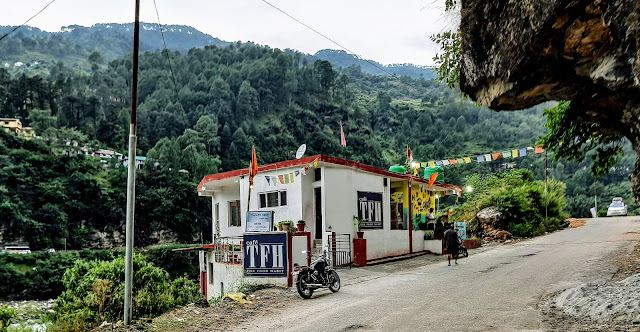
Cafe TFH - The Food Habit on Kedarnath Road. The gate near the Cafe leads to 'Eagle's Nest'. The bus on the left is on Gangotri Road.


Tilak's family belongs to Nawalgarh in Shekhawati region of Rajasthan. However, they have been staying in Delhi for over three decades. When he got a corporate job in Delhi, Tilak used to ride on his motorcycle (bike) to reach office. Over a period of time, biking became his passion. He started weekend travelling on his bike along with his close friends. In one of such group travels, he rode his bike from Delhi to Gangotri sometime in 2002. He liked the hill atmosphere so much that he made the bike ride on Gangotri road an annual feature. During such bike-rides, he had inter-acted with some sadhus and mystique men Slowly, he was drawn to spirituality. He enjoyed the tranquility in the mountains. He felt that he was more inclined towards spending life on the mountain settings than the urban concrete jungles. So, after giving much thought over it, in 2010, he decided to resign from his corporate job, leave Delhi for good and shift to Uttarkashi to be in the company of Bhagirathi River and Vishwanath temple.
In the initial years, Tilak stayed in a rented house, about 3 kms from Uttarkashi towards Gangotri side. Having left the job, he had to find some vocation in Uttarkashi which would not only keep him busy but also earn some income for the sustenance. He decided to take up the vocation for which his expertise was proven - organising mountain bike ridings (both motorcycles and bicycles), trekking expeditions, hiking to unexplored places and village walks. During this period, Tilak also completed the Basic Mountaineering Course Certification Course from Nehru Institute of Mountaineering, Uttarkashi in 'A' Grade. With this, he was now ready to start his vocation for which he set up 'Where Eagles Dares' to undertake outdoor adventure activities. He said that he was pioneer in organising the first snow-biking from Uttarkashi to Gangotri. Since then, it has become an annual event. He had also participated in season's opening of the treks in the Gangotri region like Kedartal, Tapovan etc. Among his many trekking expeditions, Tilak successfully completed Kalindi Khal Pass (5940m) which joins Gangotri region with Badrinath.
When Uttarakhand Government opened the 24-km stretch of Bhaironghati-Nelong road for Indian civilians for driving trip, Tilak along with 5 other cars were the first civilians to travel. Another feather in Tilak's cap was his concerted efforts with the concerned departments of Uttarakhand Government (such as Forest, Tourism, Public Works) to repair the damaged wooden stairs of Gartang Gali and open to Indian tourists to trek. His efforts bore fruits and in August 2021, the 2-km Gartang Gali trek was open for Indians with some restrictions. He is now pursuing with the same departments to extend the trekking coverage of Gartang Gali from the present 2 kms to 7 kms (up to a point where the trekking path meets the Bhaironghati-Nelong road).
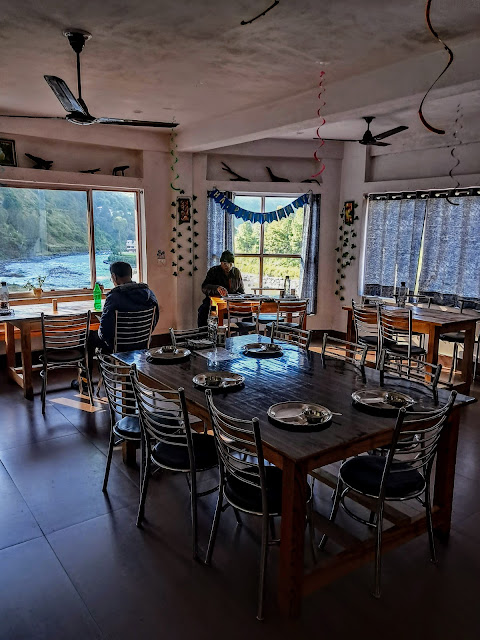
The idea of starting Cafe TFH in 2018 germinated from the need to serve his guests the varieties of food - Indian, Chinese, Continental etc. The menu card of the Cafe gives a good indication of his intent. Leaving alone in Uttarkashi away from his parents made Tilak to learn cooking. Today, he has become a good chef not only to take care of his own food requirements but also of his guests and the visitors to his Cafe TFH. He can also serve food which are not listed in the menu card, for example, Sizzlers. During our three days of stay with him, he personally cooked breakfast for us as his cook would come only around 9.00 am at that time. We had an authentic feast of South Indian dishes like Masala Dosa, Rava Dosa, Idli with filter coffee. KS had never expected that in Uttarkashi, he would get Curd-Rice with fried red chilies and curry leaves, a specialty South Indian food. The sambhar and chutney personally prepared by Tilak were testimonial to his expertise on making South Indian food. I do not think that such authentic South Indian preparations would be available elsewhere in Uttarkashi.


As I mentioned earlier, Tilak had his 'Eagle's Nest' on a rented premises. In 2018, after opening Cafe TFH, the land behind the Cafe was bought by him. After registration, he constructed his present 'Eagle's Nest' with 3 bedrooms, one of which is for his personal use. With extra beds, six guests can be accommodated in remaining two bedrooms. However, in case of need, Tilak gives his bedroom also for the use of his guests by shifting himself in an adjoining anteroom which has a separate exit. He told me that he has no plan to construct additional rooms though there are space enough to construct two more rooms. He has a plan to construct a ramp by the side of his Cafe on the right so that guests need not use steep stairs to descend from the road to reach the rooms.

Tilak gives first preference to his adventurous friends numbering about 9000 to use his house for overnight stay on their ways to/return from adventurous activities in the Gangotri region. His rooms are also available for those who need to stay somewhat longer time in Uttarkashi in pursuing their research works in the Gangotri region. Others can book the rooms provided they are referred to by his friends and rooms are available.
There is no room tariff. Instead, Tilak has left to his guest-friends to donate the money as per their ability. Tilak says that to the best of his knowledge, all the guests donated the money as per their capacity. Most of his guests donated generously. The donations are used for day-to-day maintenance of the property and for adding some more facilities for the benefit of the guests. Tilak has also made available to the guests the free Wi-Fi facilities, both in rooms as well as in the Cafe. He has good collection of books in the library which the guests can use for reference.
Tilak calls 'Eagle's Nest' as a homestay. But I would like to call it a home away from home. I have already decided that in my next visit to Uttarkashi which may be as early as next year, 'Eagle's Nest' would be my abode. At that time, it would be more of a leisure stay to have the full benefit of the culinary expertise of Tilak.