|
| Collarwali Tigress |
It was around 12.30 pm on May 6th and I was in a marriage hall in central Mumbai when I got a call from my friend K Srinivasan (KS). The call had to be an urgent one as normally, KS communicated with me through E-Mails. I came out of the hall and spoke to KS for about 5 minutes during which he told me about his intention to visit the Pench Tiger Reserve between May14-17.He said that after talking to Dr Abheek Ghosh, Cardiologist by profession and a wildlife conservation activist, he planned to be in Pench for 4 days to take 7 safari rides to improve the chances of sighting tigers. KS asked me whether I was interested in joining him for the trip for which I said in affirmation.
The trigger point for KS to take such a sudden decision was the pictures of collarwali tigress with her five cubs uploaded on Indiamike and TBHP sites by Dr Abheek Ghosh. By the end of the day, KS had booked BOM-NGP-BOM flight, the Kipling Court at Pench for our stay and remitted money to book 7 safaris @Rs.3000/- per safari. Indica AC car (Rs.2000/-) was arranged through Kipling Court to pick us from Nagpur airport for Kipling Court drop ( 105 kms). So I was set for my first full-fledge wild life trip in about week’s time.
The Indigo flight landed at the Nagpur airport on schedule (1.00 pm) with the outside temperature of 42C. From the exit point of the airport, the car park was barely 100m away where our driver Shivshankar was waiting for us. But by the time I sat in the car, I was already reeling under the impact of mid day heat. We drove through Nagpur City to take Nagpur-Jabalpur highway. Although there was not much of traffic, Shivshanker never exceeded the speed limit of 60 kmph. We thought that perhaps, he may have been instructed by Kipling Court Manager to drive cautiously on the highway. Later in the day, we came to know that he was a regular Gypsy safari driver inside Pench Tiger Reserve where the speed limit for the safari vehicle was 10 km per hour. After Khawasa village which is the border between Maharashtra and Madhya Pradesh, we took a left turn on a good single lane village road to reach Kipling Court at around 4.00 pm. The hotel was well maintained with a large lawn and a swimming pool. It was still hot outside and the first thing we did after entering our room was to switch on AC and relax for about an hour. There was a veranda attached to the room facing a dried nala and we were told that if we could sit in the veranda in the night, there was a possibility of spoting some wildlife activities. I felt that the possibility of spotting some wildlife activities may be more when there was water in the stream.
 |
| On the road to Turia gate of Pench NP |
 |
One of the tribal settlements around Turia village
We were tempted to take a plunge in the swimming pool adjunct to our room but could not do so as we had no swimming trunks with us. So, after some snacks and tea in the restaurant, we went for a stroll in the vicinity of the Kipling Court in the evening by which time, the heat had been abated. There was a helipad very close to our hotel probably for serving the VIPs visiting Pench NP. There were some tribal settlements as well as some resorts close to our hotel. We were told that there were about 20 hotels/resorts within a radius of about 5 kms from the Turia gate of Pench NP. We had an early buffet dinner in the restaurant. The food was good. Due to forest cover, the nights were pleasant and so also the early mornings during all the 4 days of our stay in Kipling Court.
Day-1 : May 15, 2011 As decided on the previous day, Dr Abheek came to our hotel at 5.00 am to take us to Turia Gate which was about 2 kms from our hotel. When we reached the gate, there were already about a dozen safari vehicles in the queue ahead of us. By the time our papers (with a photo identity card of the first named in the list of safari riders) were checked and a guide allotted to us from the roaster, it was 6.15 a.m. when we were given a go signal to enter the park. We were allotted Route No. 1 – Piyorthadi-Beejamatta-Rayyakassa-Karmazari-Zandimatta-Tirah-Jodamatta. and within one kms of ride on the Piyorthadi road, we saw herds of spotted deers roaming on both sides of the trail. Our guide, Motiram was very knowledgeable and he spotted for us many birds, such as woodpeckers, seven sisters, barbette the most common one being Indian Rollers. We also spotted collared scops Owl. Motiram told us that the density of spotted deers in Pench NP was the highest among all NPs in India. We also spotted sambhars and langurs in large numbers. The trail reached almost a dead-end at a large meadow skirted by Pench river backwaters. The place was very scenic and it was stated to be one of the favourite place of Badi Mada ( Elder female)Tigress and her two cubs. At the far end of the meadow, herds of spotted deers, a few peacocks and a solitary jackal were spotted by us. |
 |
| Safari vehicles in queue at Turia gate at 5.30 a.m. |
 |
| Safari trail to Piyorthadi |
 |
| A male Sambhar crossing our safari trail |
 |
Indian Roller
We waited in the middle of the meadow facing the backwater for sometime but in the absence of any deer or langur alarm calls, our guide felt that predators may not in the close proximity of backwaters. So we drove back on the trails and decided to take our chances in Beejamatta waterhole later, the favourite place of Badi Mada Tigress and also of Collarwali Tigress which was the offspring of the former tigress. Motiram explained to us that tigresses some time shared a part of their territories with their own female cubs when they were unable to establish their own territories when they grow up. When male cubs become adults, they have to establish their own territories as other tiger/tigresses would not share their territories with them. Halfway to the Beejamatta, Motiram suddenly heard the alarm calls of a spotted deer and also of a langur. He signalled our driver to stop the vehicle and switch off the engine. He told us in a hush voice that these calls indicated that there may be some predators around. We also observed that a large herd of spotted deers stood on their ground almost motionless with their ears errect. Soon a male spotted deer who was leading the herd, moved forward very cautiously probably doing reconnaissance of the area. In the meanwhile, one more Gypsy came and stopped behind us. Motiram instructed the driver to switch off the engine. In the meanwhile, the leading male deer who had barely moved not more than 50m during the past 10 minutes, stopped and waited for a long time looking to his left towards a forest ridge. That was when Motiram spotted the tiger descending from the ridge, the same direction to which the male deer was looking at. |
 |
| The scenic Pench river backwaters |
 |
| Spotted deers crossing safari trails on our way to Beejamatta |
 |
| A Woodpecker |
 |
| A Collared Owl |
 |
Peacock on a tree trunk
|
Assuming that the tiger may come down from the ridge and cross our trail some 200m ahead of us, we quickly drove to that point and waited for the tiger to cross the trail. But the tiger which Motiram now identified as a grown up cub of Badi Mada tigress, changed his mind and started walking away from us under the cover of forest and dried grass towards the ridge. Probably our two Gypsies' noise must have disturbed the cub and decided to go back to the safety of ridge where Badi Mada tigress must have been watching us from a vintage point. I could see the cub very clearly walking away from us in the cover of forest and dried grass but could not bring my camera to the focus to capture what would have been my first shoot of tiger in the wild. However, KS could somehow capture the retreating tiger cub in his camera. While we were busy locating the whereabouts of the tiger cub, Motiram spotted another tiger cub some 200m behind us descending towards our trail. We quickly took a U turn towards the spot expecting the second tiger cub to cross our trail but the tiger cub was nowhere to be seen. Motiram felt that the cub might have already crossed the trail before we reached the spot.
Disappointed by the turn of the event that unfolded during the last half-an-hour, Motiram decided to move our Gypsy to Beejamatta waterhole assuming that Badi Mada tigress with her two cubs may have gone to cool off in Beejamatta waterhole. We reached Beejamatta in the next 10 minutes or so and waited patiently there for some time. But there were no traces of the tigress and her two cubs. Since there were no alarm calls, Motiram felt that there was no possibility of sighting the tigress and her two cubs in this area. My guess was that the tigress and her siblings must have decided to cool off in one of the wet patches of almost dried up stream somewhere in the midway where no jeep safari could reach.
At the end of our first safari, we returned to our hotel at 10.30 a.m. At the breakfast table, while discussing the morning safari events, KS jokingly told me that tigress and her cubs cleverly hoodwinked us. A thought came to my mind later that after all she was Badi Mada tigress (Elder female tigress) with many years of experience in dealing with peeping tourist crowd. In the milieu, she must have mastered the art of hoodwinking the tourist crowd!!! If deers and langurs can give alarm calls after sighting predators, so can Badi Mada tigress give her own call to cubs after sighting two legged animals called human beings. By the way, we did not see Badi Mada tigress and her two cubs in our remaining six safaris.
 |
| Alert spotted deers wait after hearing alarm calls signalling predators nearby |
 |
| A zoom shot of Badi Mada tiger cub retreating to forest after seeing us. Photo courtsey: K Srinivasan |
 |
| We in our safari Gypsy on way to Beejamatta. |
 |
| Beejamatta Waterhole |
 |
Langurs take rest in a shade on our safari trail
Dr Abheek had arranged a driver with a Gypsy to pick us up from our hotel at 3.30 pm for our afternoon safari. The day was very hot and we were not sure whether we would enjoy the safari in such a hot weather. It was a blessing in disguise as our Gypsy came at around 4.00 pm for pick up and we entered the Turia gate at around 4.30 p.m. There were fewer safaris in the afternoon as compared with the morning safaris. This time we had a slightly different route allotted : Kalapahad- Piyorthadi-Beejamatta. With such a hot weather and afternoon being generally the resting time of tigers, we did not see any tigers in this safari. We, however, saw some more bird life, other wildlife activities and a grand sun set view on the banks of Pench backwaters. Towards the evening, we passed through some rocky terrains in our return journey which looked to be a perfect hideout for Leopards. It was my wishful thinking that we may see some Leopards resting on one of the rocky patches or resting on some tree trunks. We had no such luck. Our guide decided to return to the gate via Beejamatta to take a chance if tigresses and her cubs could be spotted at the waterhole in the evening. We had no such luck either. |
In the night, Dr Abheek informed us that his preferred driver Bablu will be back from Kanha National Park and he would be assigned to us for our remaining 5 safaris. He was supposed to be an ace spotter of tigers in Pench. He has good knowledge of the topography of the park and a keen interest in wildlife.
 |
| A Sambhar family |
 |
A grand evening view over Pench backwaters
May 16, 2011 : Day of Jackals, Indian Bisons and Collarwali Tigress We started our morning safari at 5.30 am with Route No.1 ( same as previous day’s morning safari). Dr Abheek joined us at Turia gate. It was almost a repeat of the same initial sightings – herds of spotted deers, sambhars and lots of birds. However, for the first time, we sighted wild boars as we were nearing Pench backwaters meadow. We stopped our Gypsy near the stream which was supposed to be patronised by Badi Mada tigress and her two cubs. We waited for some time to see whether there were any activities from predators. The absence of any alarm calls during our wait indicated that there was no likelihood of the presence of any predator. During our stop, we noticed a family of jackals playing on a grassy patch just across the stream. Bablu decided to take our Gypsy slightly nearer to the spot where jackals were playing to enable us to take better pictures though we were still about 200m away from Jackals. Our Gypsy engine’s noise must have made Jackals panicky and soon they started running away from the spot – surprisingly one by one rather than in group and disappeared in the forest at the far end of the meadow. In our zeal to take good pictures, we seems to have deprived the Jackal family a long rendezvous in a scenic setting – backwaters on the one side, forest on the other side and a stream bisecting the meadow, a perfect picture post card scene. |
 |
A family of Jackals
We then moved away from the backwaters to the interior where we had seen Badi Mada tigress’s cubs in the previous morning. This time, we were blessed with the presence of a group of 10-12 Bisons walking very close to our Gypsy probably intending to cross our trail. We stopped for about 15 minutes to observe Bison family which seemed to ignore our presence. There was one calf accompanying the Bisons and the group ensured that the calf was in the middle while moving from one place to another.
As we drove further towards the direction of Ali Katta, Dr Abheek pointed out a jackal running with a leftover of a deer kill. Generally scavengers disappear quickly after getting hold of the kill but this jackal was running aimlessly to his right and left and some time in circle. As a result, we could observe him for about 10 minutes with the leftover of the kill, now identified as the deer’s leg and hip. Was it trying to hoodwink the potential scavengers from the scent of the kill? Finally, the Jackal disappeared in the cover of bushes and shrubs. |
 |
| Deers watches as a Jackal (top left) takes away a part of deer kill |
 |
A Bison with her calf
We reached Ali Katta, a central point for all the safari routes where some of the safari vehicles were already parked. Apart from being a rest room stop, Ali Katta is the base for elephants who are deployed for short rides for what is called as ‘tiger show’. In the early morning, a mahout on his elephant scouts for the tigers in the forest and if tigers are tracked and the place is approachable by elephants for a good viewing, the park authorities announce the tiger show. Tokens for elephant rides are issued at Ali Katta on ‘first come first served basis’. If the tigers are spotted, elephant rides generally starts around 7.00 a.m. and ends on or before 10.00 a.m. depending upon how long the tigers will be present on the spot. For instance, the previous day, the elephant rides were discontinued after four rides as tigress and her cubs decided to move away from the spot to some other location which was not approachable either with jeep safari or elephant rides. So getting a token for elephant rides does not guarantee that one will be able to spot tigers. Also elephant rides for tiger show may not happen if the tigers are not tracked.
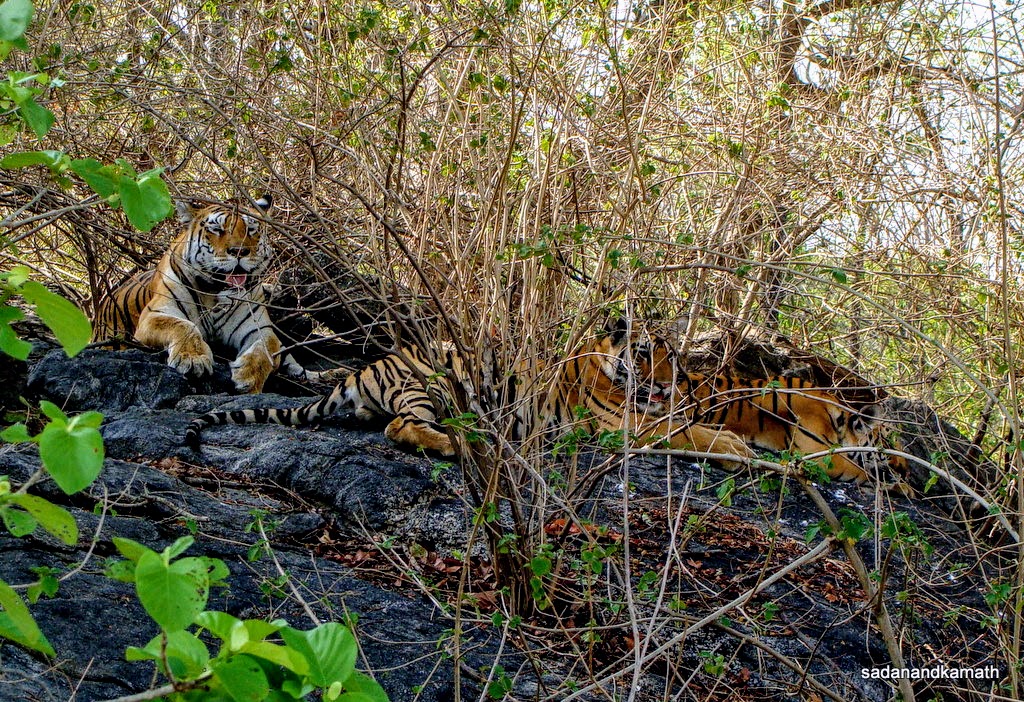
We had earlier got the news that Collarwali tigress and her five cubs with a Neelgai kill were spotted at a waterhole about 2 kms from Ali Katta. We were lucky to get the token for the last elephant ride of the day for tiger show. After driving in our safari Gypsy for about 2 kms, we reached the elephant boarding point where some 6-7 safari vehicles were already in queue. We noted that there were two elephants deployed for the ride taking 4 tourists each and the ride took about 15 minutes to finish. After about 30 minutes, we got our turn for the elephant ride. We paid Rs.200/- per head and climbed on a aluminium ladder to reach the elephant-back seat. After about 5 minutes of ride, we spotted a tiger cub resting on a rocky mould under the cover of shrubs and other two cubs in deep slumber nearby. The remaining two cubs were partially seen just above the sleeping cubs. When elephant took a turn for the return, we saw collarwali tigress resting on a rocky wall depression with her half eaten Neelgai kill. Surprisingly, I did not find any vulture hovering around the kill to create the nuisance to the tigress though we had seen many vultures in the park during the course of our safari. We took many pictures of cubs and tigress but there were limitation in taking pictures in desired angle from an elephant ride when it is packed with four passengers. Moreover, mahout stops the elephant not even one minute to take pictures which is not sufficient to compose perfect pictures. At the same time, it would be risky to stop elephant for long time as tigress with her cubs around could be unpredictable.
|
 |
| Tourists on elephant rides for watching collarwali tigress and her cubs |
 |
| Collarwali tigress with her Neelgai kill |
 |
| Two of Collarwali tigress's five cubs in deep slumber after a hearty meals of Neelgai |
 |
One of five cubs takes rest under the shade of shrubs
At the end of the elephant ride, we were more than satisfied in viewing collarwali tigress and her five cubs. Fortunately, some of the pictures of collarwali tigress and her cubs came out perfect. I was told that though it may not be rare for a tigress to give birth to five siblings, it was a rare case where all the five cubs have survived and now they are 5 month old healthy cubs. It is a herculean task for a tigress to protect her five cubs from other predators in their formative months when they unknowingly tend to move away from the protective glare of their mother. This speaks volume for the caring and protective nature of collarwali tigress.
Dr Abheek had left for Nagpur in the afternoon to attend to his hospital duties but told us that he would try to join us on Wednesday morning on our last safari ride. He was confident that Bablu would get us to more tiger sightings.
We started late for the afternoon safari at around 4.30 a.m. to avoid heat. Earlier, Bablu had got news from the forest guards that Baghini Nala tigress and her two cubs had been spotted near Baghini waterhole. So he decided to drive to Baghini Nala first even though as per the sequence of the allotted route, we were to return via Baghini Nala. But our guide was not comfortable in deviating from the allotted route. In fact two forest guards were deployed at Baghini Nala to check the overcrowding of safari vehicles there. We saw some of the safari vehicles being sent back from Baghini Nala by the forest guards for deviating from their allotted routes. Under the circumstances, Bablu decided to reach Baghini Nala by taking a longer route so that by the time we reach, it could be construed that we were on our return journey via Baghini Nala as per the sequence of the allotted route. In this way, we reached Baghini Nala at 5.30 p.m. There were 4-5 safari vehicles already stationed at the vintage point of Baghini Nala. We waited for about 30 minutes but there were no trace of tigress and her cubs. There were no alarm calls either. Bablu was quite confident that the tigress and her cubs would come out of the hiding in the late evening to the waterhole and perhaps we will have to wait here for longer time. We waited up to 6.30 p.m. the closing time of the evening safari during which time, we had sighted a jungle cat moving in the shrubs close to our Gypsy and vanishing into the forest. We also spotted some birds during our wait but no sight of tigress and her cubs. Since it was getting dark and we had exceeded the closing time of the park by 15 minutes, we decided to call off the safari and return to the gate.
After dropping us at the hotel, Bablu apprised us of his plan for the next day’s morning safari. He was confident that we would spot the tigress and her cubs next morning if we were first to reach the Baghini Nala. So he requested us to be ready at the hotel by 4.30 a.m. to be first at the Turia gate the next day morning. |
 |
Baghini Nala
May 17, 2011 : A day of tiger galore. As planned, Bablu picked us from our hotel sharp at 4.30 a.m. and we were the first in queue at Turia gate and first to enter the park at 5.20 a.m. We reached Baghini Nala by 5.30 am and before our Gypsy was parked at vintage point, I saw a tiger sitting on the check dam earthen extension, about 100m away from us. Bablu recognised it as one of Baghini Nala tigress’s cub. The cub looked at us and then turned his face on the other side. But he was unperturbed by our presence and continue to sit in his pose. We clicked many pictures of the cub but we were not sure as to how the pictures will come out due to poor light. In the meanwhile, another Gypsy came and stopped behind us. At this juncture, the cub got up and started walking away from us towards the slope leading to the ridge. Halfway through his walk, he was joined by another cub who came out from the shrubs below the earthen extension of the check dam and both walked towards the slope. The first cub after looking back and forth decided to sit on the slope while the second cub descended in the shrubs not to be seen thereafter. Bablu took out his binocular to look for the second cub but in the event, he found out that in the diagonally opposite direction of the first cub, Baghini Nala tigress was sitting on a vintage point from where she could keep an eye on her cubs as well as on us but she was not visible to our naked eyes. It would now appear that after seeing the second Gypsy, the mother must have given a call to her cubs to come nearer to her. It was very difficult to cover both the first cub and the mother in the shot even with our optical zoom equivalent to 300mm zoom lens as light was not sufficient. We still took random shots assuming that at least a couple of shots will some out well. |
 |
| One of the two cubs of Baghini Nala tigress resting on the earthen extension of check dam at 5.30 am. |
 |
| The second cub joins the first cub in retreating to a higher slope |
 |
| The first cub sits on a higher slope and scratches his body with one of his rear legs |
 |
Now the first cub and Baghini Nala tigress ( top right) in one frame
|
So, Bablu was correct in assessing that Baghini Nala tigress and her two cubs were holed up here. With two Gypsies with 10-12 persons, there was no way in expecting that the tigress and her two cubs will move towards us to give us a better darshan. On the contrary, tigress and her two cubs moved away to the other side of the ridge after hearing the noise from a bike on which two forest guards arrived at Baghini Nala to regulate the safari vehicles.
Encouraged by the yesterday’s sighting of collarwali tigress and her five cubs on elephant ride, we decided to have one more elephant ride for a relook. So we drove towards Ali Katta. Just one km before Ali Katta, we passed through a beautiful meadow with a small pond. This was a very scenic spot worth spending some time. So even at the cost of delay for the elephant ride, we decided to spend sometime in the midst of this meadow. There were herds of spotted deers, a couple of dancing peacocks, red ring-necked Parakeets, black beek Storks and Pond Ibis (Heron?) all sharing the same pond. On the trees surrounding the meadow, we saw a group of yellow legged Pigeons for the first time. Occasionally, Parakeets and Indian Rollers flew over the meadows.
 |
| A vast meadow on way to Ali Katta |
 |
| Yellow legged Pigeon |
 |
| Deers, black beek storks and rose ringed neck Parakeets ( in the foreground) around waterhole |
 |
| At the same waterhole, a peacock (left) dances |
 |
| Pond ibis |
 |
| A flying Indian Roller |
At Ali Katta, we got a good news that elephant rides were going on to see collarwali tigress and her five cubs at the same spot as we had seen yesterday. So we got the token for the elephant rides and drove to the elephant boarding place. As we reached the place, we came to know that collarwali tigress and her cubs had moved further up away from the banks of the stream necessitating the forest authorities to shift the elephant boarding place a further 200m away. All the safari vehicles in the queue were directed to form the fresh queue in the same order. After about 30 minutes, we boarded for the elephant ride and less than two minutes, we spotted the first cub in the bush looking at the elephant but did not panic. Just few feet away were two more cubs sleeping under the cover of bushes. At some distance from these cubs were the collarwali tigress with her two other cubs sharing the same rocky mould. While the cubs were sleeping, tigress was resting. After taking some quick pictures of tigress and her cubs, we returned to our base where our Gypsy was parked. This sighting of collarwali tigress and her five cubs was better than the one of yesterday as we got to see them more or less together.
 |
| Collarwali tigress with her two of the five cubs resting on a rocky mould |
 |
| A close up of collarwali tigress and her one of five cubs |
 |
| Another cub is resting behind the shrubs |
 |
| One more cub under the shrubs |
We must have barely drove some 300m on a connecting trail to Turia gate, when we saw a Gypsy stopping and its occupants all looking towards the pond. What we saw was a mind blowing sight of 4 of collarwali tigress’s cub in the pond to cool off. After sometime, they were all looking at the direction where we had seen the tigress. Later it transpired that collarwali tigress was moving towards the pond to join the cubs. It was the most beautiful sight to watch some 300m away from us, tigress and her four of five cubs playing and swimming in the pond. The fifth cub did not join as we had seen earlier, it was in deep slumber in the cover of nearby bushes. Some more safari vehicles arrived and this prompted collarwali tigress to keep a watch over us while two of the four cubs were looking to cross over to a grassy patch for a walk. But they soon returned to the pond probably to cool off than walking in the heat.
At this point of time, forest guards asked us to move away from the spot as it would have disturbed the tigress and her cubs apart from jamming the narrow trail. I was just visualising a scenario in which if collarwali tigress felt threatened with our presence, she could just come charging towards us from a distance of about 300m and we would have no time to run away even in our Gypsy. This reminded me of an incidence in Kaziranga National Park few years back where a tiger suddenly came charging and jumped on elephant mahout injuring him badly. It is said that tigers leave their mesmerising impact on their viewers and in that process, they tend to forget about the impending danger from them. So the forest guards were right in cautioning us especially when tigress had cubs with her.
This was the best sighting of our safari and we wished we had longer zoom lenses to shoot the pictures. At the end of the morning safari, KS said “Paisa Vasool” (worth the money). There was a background to this statement. I was thinking that the cost of 4 days trip to Pench NP was working out more than the cost of our proposed 12 days trek. But we felt that if we got to see tigers, it was worth spending money. At the end of five safari rides, we had already seen 10 tigers (including cubs).
 |
| Four of the five cubs in the pond for cooling off while Collarwali tigress joins them later |
co |
| Now cubs with Collarwali tigress (right) |
 |
| Collarwali tigress (right) looks at us while two of her cubs want to go on the other side. |
 |
| Three cubs who had gone outside the pond come back in the water to join Collarwali tigress (right). |
As usual, we started our afternoon safari late by one hour to avoid heat. We got slightly different route covering trail towards Karmaziri and returning via Baghini Nala. We were now hoping to see male Tigers and Leopards in our remaining two safaris. There were not much of new wildlife sightings other than those already seen by us. Motiram, the guide on our first safari had told me that with more tiger population in Pench requiring larger territories for them, some of the leopards were driven out to nearby forests. Even though there are still more leopards than tigers in Pench, the chances of sighting leopards are low because they are shy animals. Within the tigers, sighting a male tiger is more difficult than female ones as the former has to protect his large territories and in that process, the male tiger is always on the move. Bablu told me that few days back a male tiger was sighted near the Turia gate but the chances of sighting him again in a day or two around Turia gate were low as he would be moving to other areas of his territories to ensure that he remained undisputed king of his territories. On the other hand, spotting tigresses is relatively easy as their territories are smaller than that of the male tigers and if they have cubs with them, their movements become further restricted.
With no chance of sighting male tigers and leopards, Bablu decided to take one more chance at Baghini Nala in the late evening to spot Baghini tigress her two cubs. But again we had no luck. All our afternoon safari ended without sighting any predators. When we were back in the hotel, one of the hotel guests told me that he was lucky to spot Badi Mada tigress and her two cubs crossing the road very close to his safari vehicle in the late evening today. He showed me the pictures of Badi Mada tigress crossing the road.
 |
Evening sun rays peeping through the clouds in Pench NP
May 18, 2011 Today morning safari was our last one. We were allotted a new area which was not visited by us during our last six safaris. The route had less forested areas than the ones we saw earlier and for the first time, we saw very few spotted deers and sambhars. But we came across a herd of Neelgai, a Bison and a mangoose crossing the road, dancing peacocks at a waterhole and a serpent eagle.
We had to cut short our safari at 8.45 a.m. to return to hotel and leave for Nagpur Airport at 9.30 a.m. to catch an early afternoon flight to Mumbai. We engaged the same Indica AC car and driver Shivshankar for a Nagpur Airport drop (Rs.2000/-) thus ending our 4 days of rendezvous in Pench Tiger Reserve. |
 |
| A Neelgai looks at us while waiting to cross the safari trail |
 |
| A Bison rushes to cross the safari trail before our Gypsy |
 |
| A smiling langur family |
 |
| Serpent Eagle |