Thursday, March 19, 2015

Temples of Halebeedu and Belur - A Photoblog

I had visited Belur, Halebeedu and Sravanbelgola in 1991 as a day trip from Bangaluru. However, for want of suffiient time, I could not explore fully the two main Hoysala temples - Chennakeshava temple and Hoysaleshwara temple constructed during 12th Century AD. Since we were already in Chikmagalur, we decided to revisit these temples which are located within about 40 kms from the town.
 
After exploring Kodandarama temple in Hiremagaluru and Veera Narayana temple in Belavadi, we proceeded to first to Halebeedu and then to Belur. We engaged  the tourism department approved guides for both the temples to understand the thoughts behind carvings, sculptures, reliefs and frienzes. We ended the trip by visiting Yagchi dam backwater for a speed boat ride and returned to Chikamagalur by evening. There are empteen blogs and articles available in books as well as on the websites on the temples of Belur and Halebeedu. So I will not go into the details of these two temples. I leave it to pictures taken during the visit  to 'speak' about them. Additionally, I have also captioned these pictures for further elucidation.
 
Some pictures of Hoysaleshwar temple taken during the visit to Halebeedu are uploaded below:
 
1. Hoysaleshwar Temple, Halebeedu
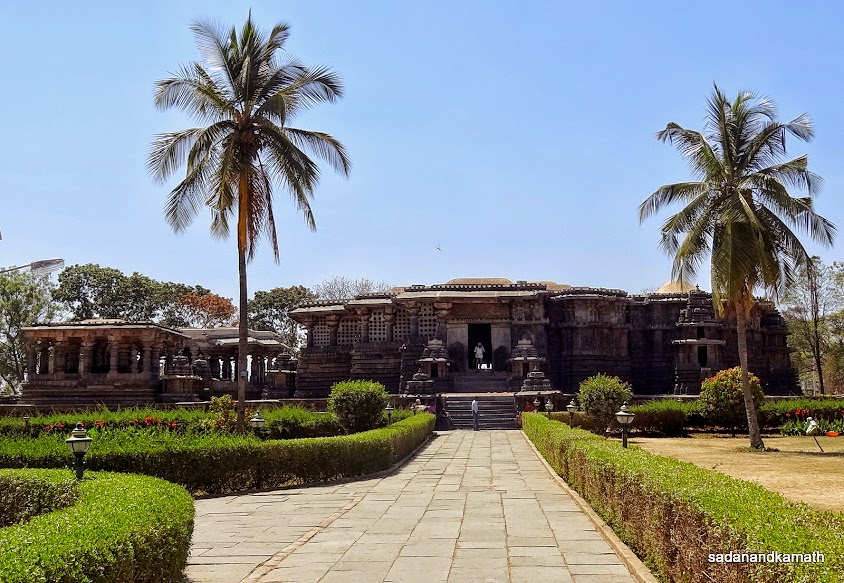
 
Front view of of the twin temples of Hoysaleshwara and Shantaleshwara in Halebeedu. These are Shiva temples constructed during 12th Century AD.
 
One of the well carved black stone pillars inside Hoyleshwara temple.
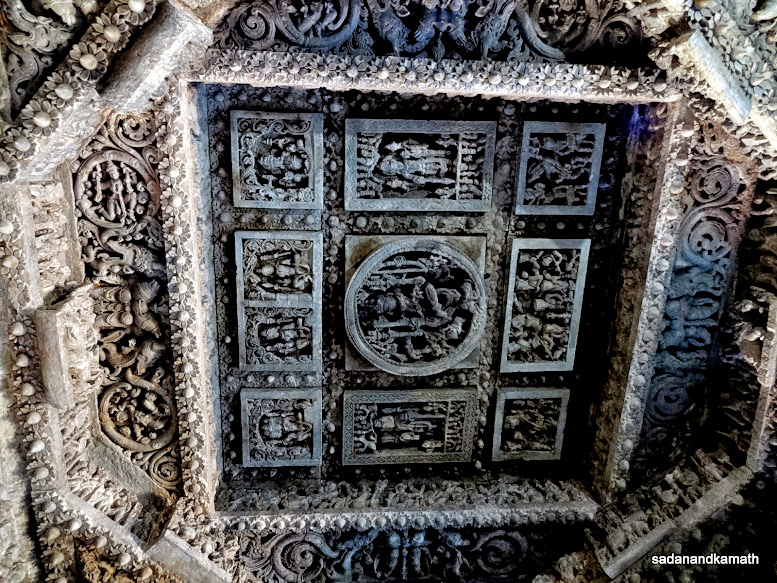
 
 
One of the stone carved ceilings depicting the dashavataras of Lord Vishnu.
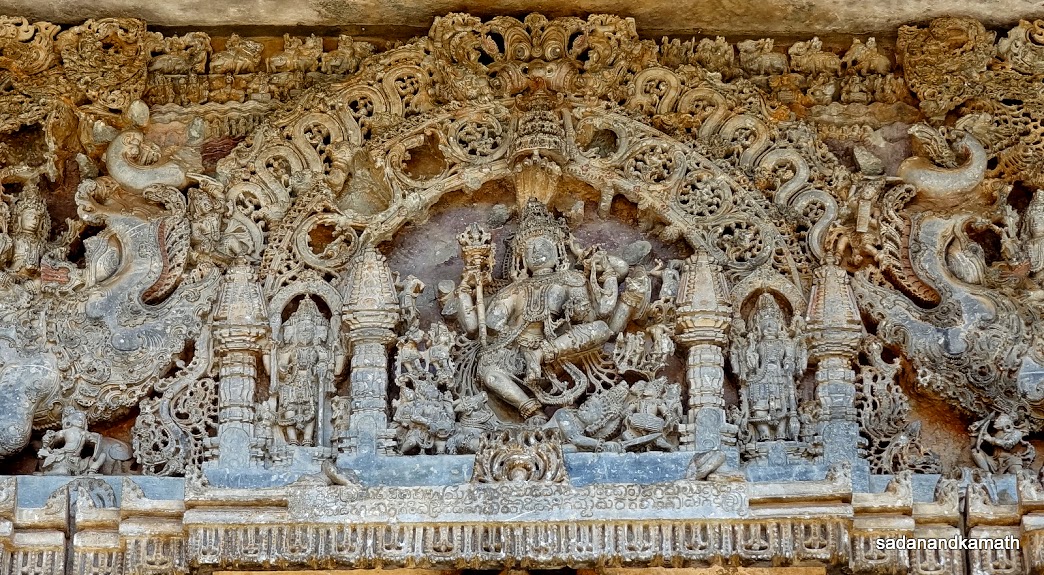
 
The close up of the intricately stone carved over the door leading to sanctum sanctorum of Hoysaleshwara temple.
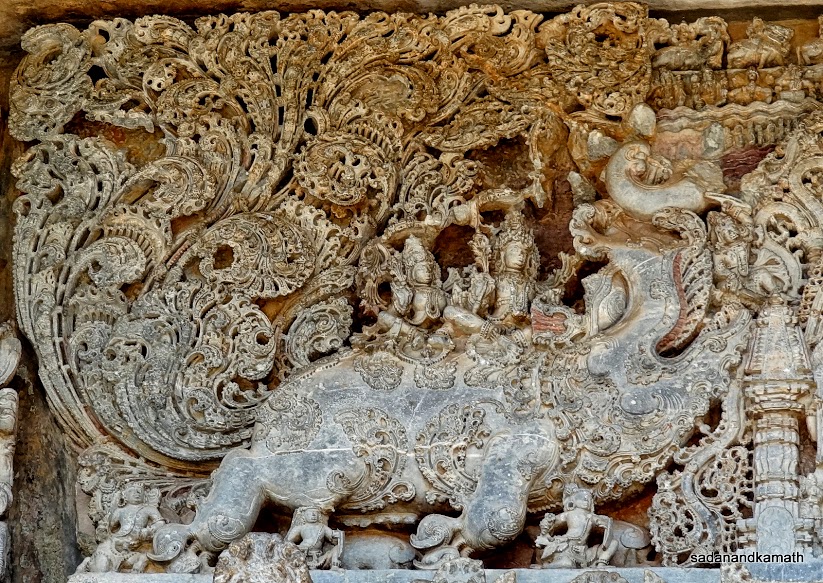
 
 
The lose up of the mythologial animal over the door frame.

A monolith bull made u of black stone in front of Hoysaleshwara temple. A similar size bull sculpture is also placed in front of the adjunct Shanteshwari temple.
 
 
Halebeedu Shiva temple have more carvings, sculptures and motifs on the outside walls of the temple than inside the temple. This one is a sculpture of Ravan who is seen holding Mount Kailash. Note how Ravan is balaning the weight of the entire Mount Kailash on his legs. 
 
Lord Vishnu on the left and Harihara ( Shiva and Vishnu together) on the right.
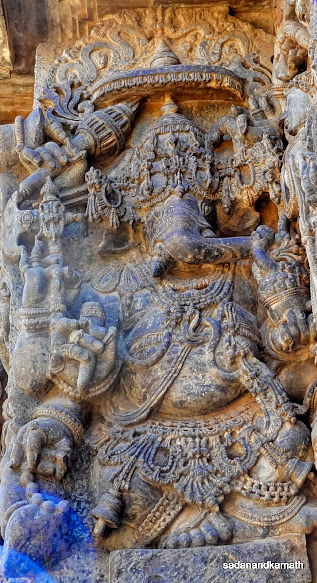
 
Lord Ganesh with trunk on his left. 
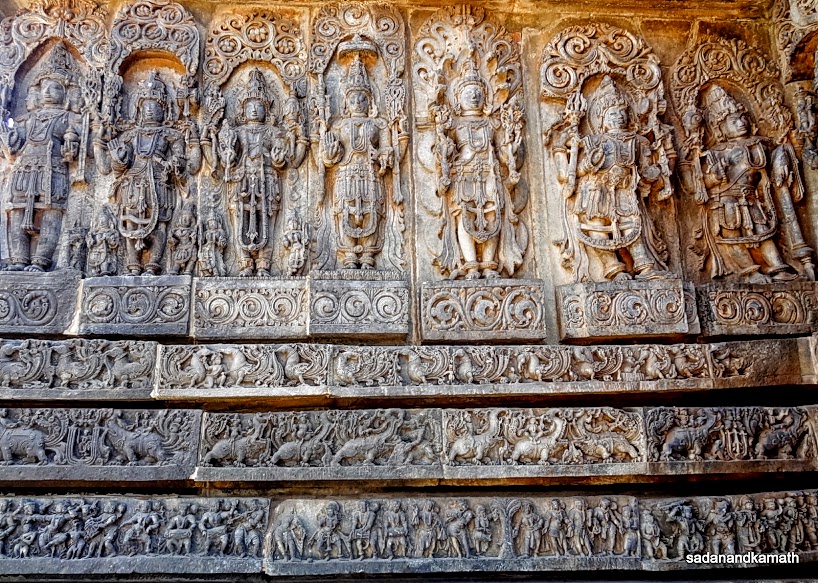
 
The friezes from down to up of social activities, animals, birds and flowers upon which are some idols of gods.
 
 Lord Bramha.
 

Arjuna with his bow pointing up during Draupadi Swaymvara.
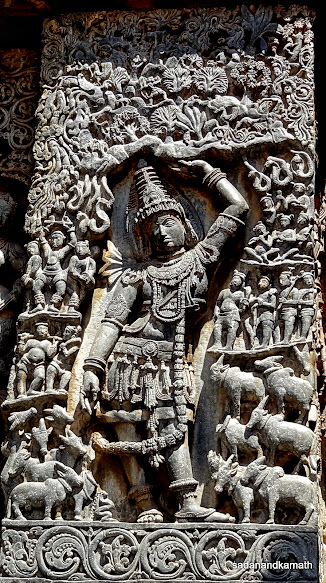
 
 Lord Krishna holding Mount Goverdhan.
 
Lord Shiva, probably in Param (Supreme) Shiva form.
 
Lord Vishnu in Varaha avatar.
 
 Dancing Saraswati with beads on her right hand and a book on her left hand.
 
Ugra Narasimha Avatar.
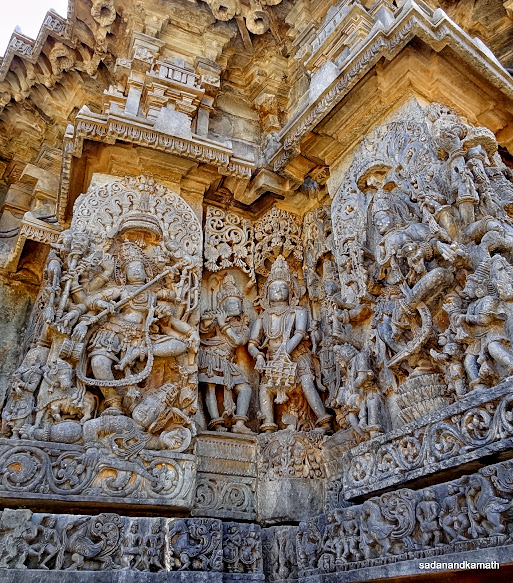
 
Corner carvings and sculptures.
 
Karna-Arjuna war.
 
Lord Vishnu in Trivikrama form. Lord Vishnu takes a giant leap to reclaim universe. Lord Bramha, the creator of the universe is at the end of the raised foot.
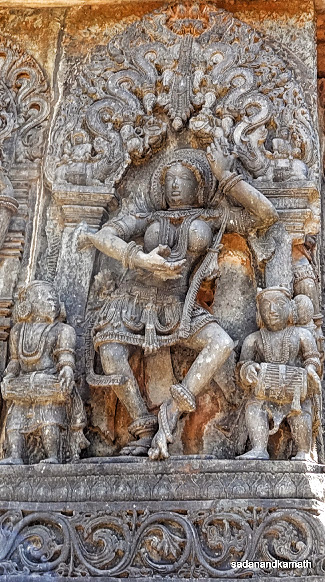
 
A dancer aompanied by two drummers on her either side.
 
A monkey tries to pull a lady who is holding a tree branch in one hand and holding on to her cloth with other hand.
 
Karna is holding on to Arjuna and Bhima(left) while Chkaravuya (right) has been created to trap Abhimanyu.
 
Bhima is about to kill Dushashan (right) while Draupadi who has taken vow not to tie her hairs (middle) until Dushashan is killed, now ties her hairs (left).
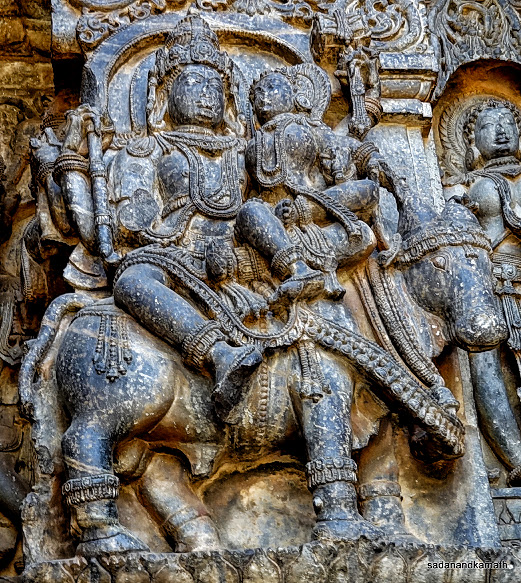
 
Lord Shiva and Parvati sit on Nandi who seems to be  grumphy due to double weight.

 
A scene of Amritmanthan. Note that heads of all the persons involved in this act have been damaged by vandals.
 
Halebeedu Museum inside the temple complex. Photogrphy inside the museum is prohibited.
 
A fully bloomed jacaranda tree in the Halebeedu temple complex.
 
2. Chennakeshava Temple, Belur
 
Gopuram at the entrance of Chennakeshava temple, Belur. This picture has been taken from inside the temple complex. From the structure as well as sculptures on it, the gopuram seems to be a later addition and is in the style of Vijaynagar architeture as seen in Hampi temples..

The side view of Chennakeshava temple, Belur.
 
 The pillar made from a single stone in the Belur temple complex. The pillar stands on its own gravity.
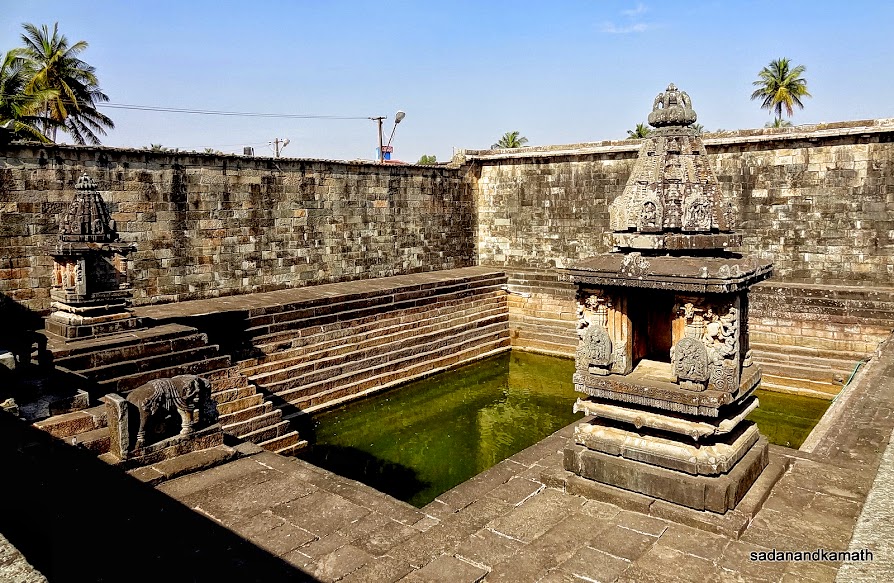
 
Pushkarni well inside the temple complex.
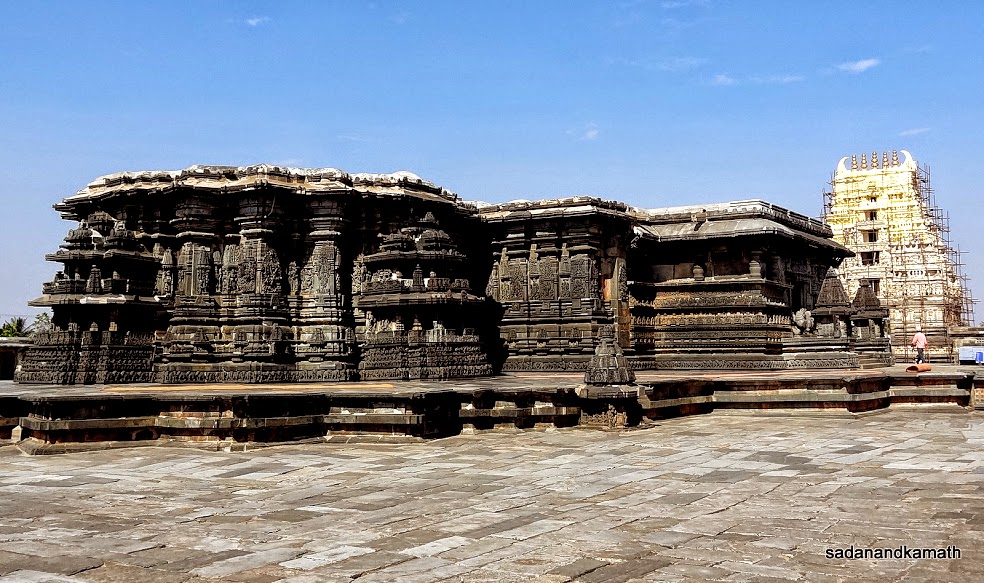
 
 Backside view of the temple.
 
A close up of the back side of the temple.
Entrance to Chennakeshava temple sanctum sanctorum. Note the intriate stone carvings.
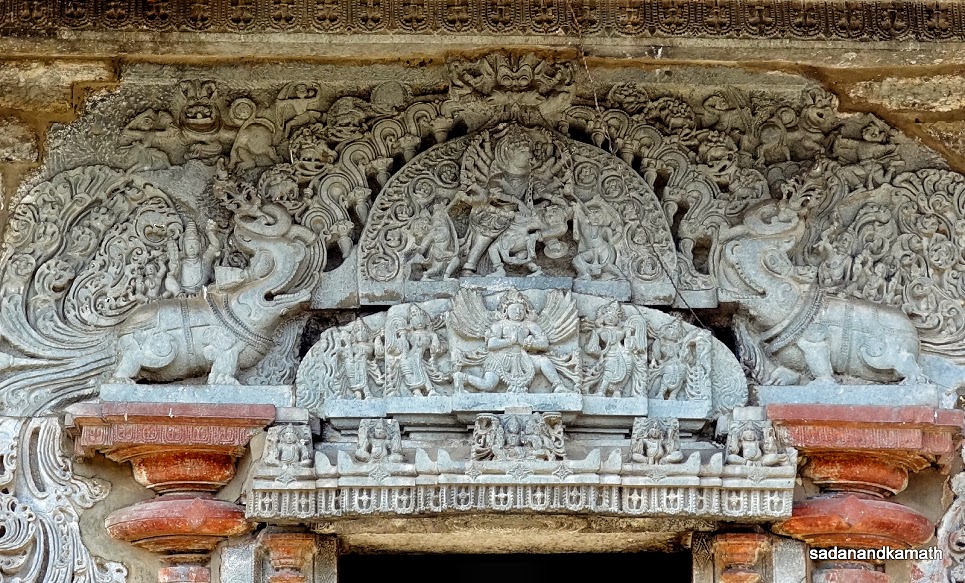
 
 
The close up of the intricate stone carvings at the entrance.
 
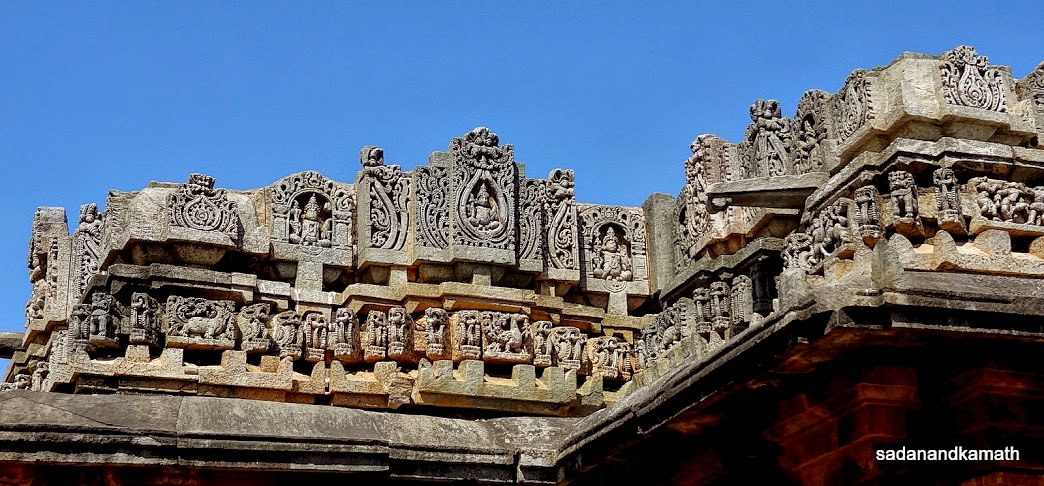
A close up of the side view of Chennakeshava temple with miniature towers.
 
Friezes in layers on the outer wall of the temple.
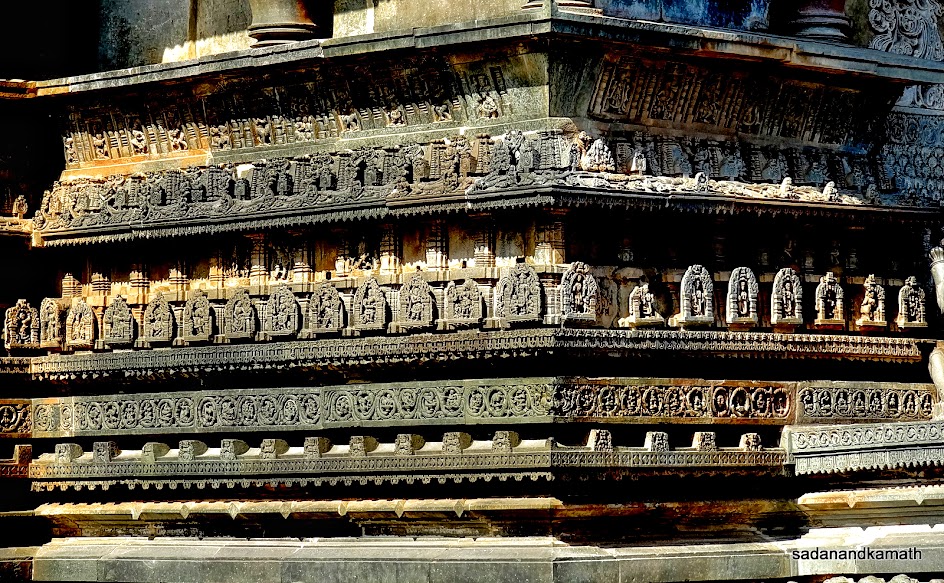
 
A different type of ornamentations on the lower outer wall of the temple.
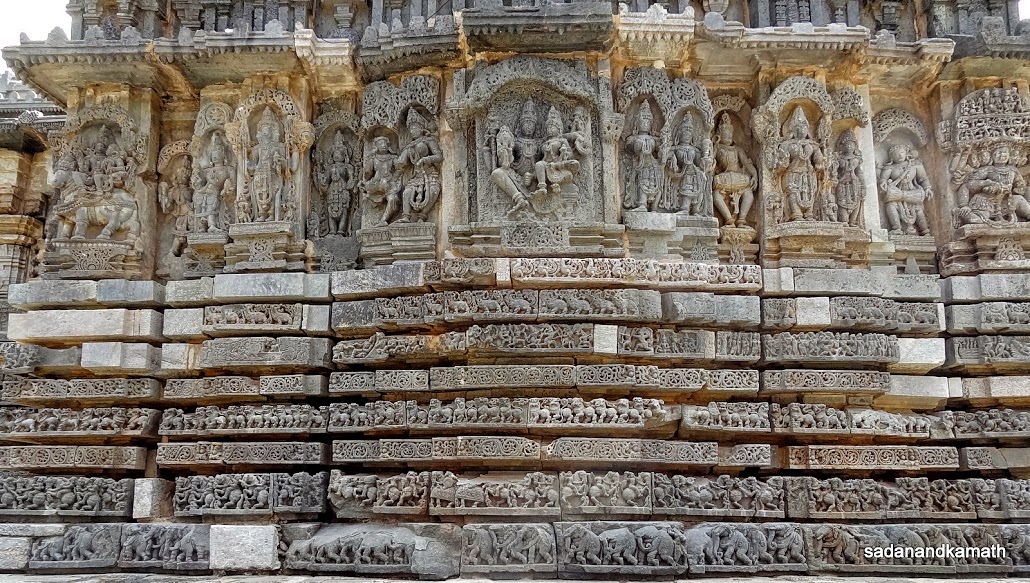
 
The layers of friezes upon which sculptures of Gods, musicians and others have been placed. In almost all friezes, the order is elephants in the bottom, followed by horses, flowers, mythologial animals, flowers, war scenes, etc.
 
There are 38 well carved bracket figures, called Madanalikas which are on the top of 38 outer pillars of Chennakeshava temple. It is difficult to imagine that the intricate carvings on each of 38 Madanalikas are in fact the stone carvings. In this picture is the dancing lady with a lady drummer and lady musicians on either side of her feet.
 
Darpan Sundari.
 
 
A monkey on the left is trying to pull the cloth of the maiden.
 
Bhashmasur mardini-Mohini dance.
 
Vish Kanya (Dame of Poison).
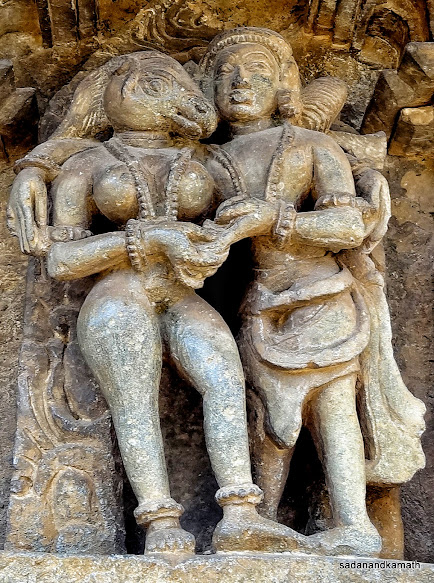
 
This sculpture is symbolic of the saying  that for an adolescence boy, every girl looks beautiful even if the she has donkey's face!
 
Lord Shiva slaying demon Gajasura.
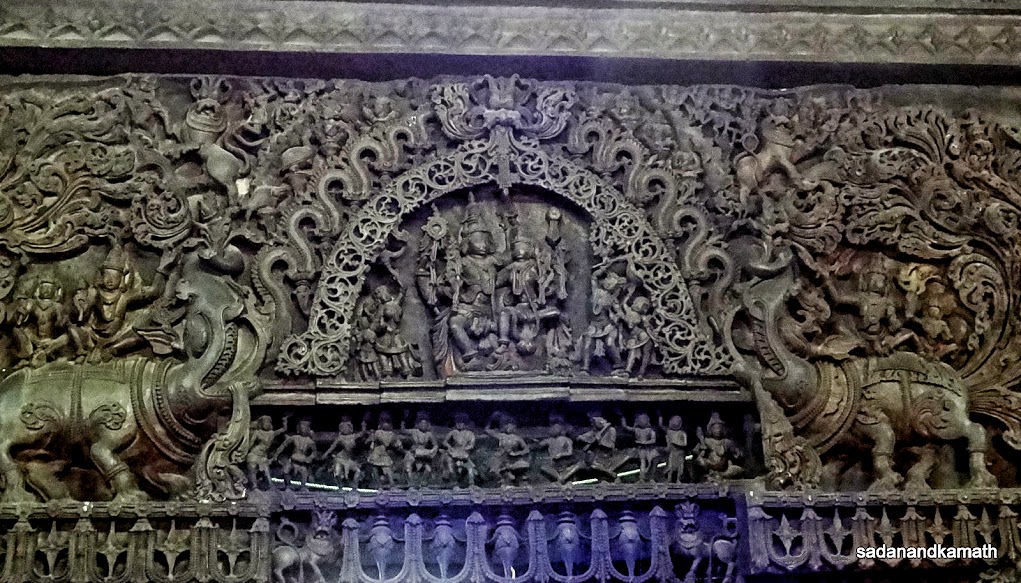
 
Intriacately stone carved top of the entrance to the sanctum sanctorum of Chennakeshava temple.
 
There are sculptures of six Shilabalika (celestial maiden) atop six pillars of the central part of the mandap of Chennakeshava temple.This is one of the six sculptures in Bashmasur Mohini dance pose.
 
The sculpture of a celestial maiden doing hiar dressing.
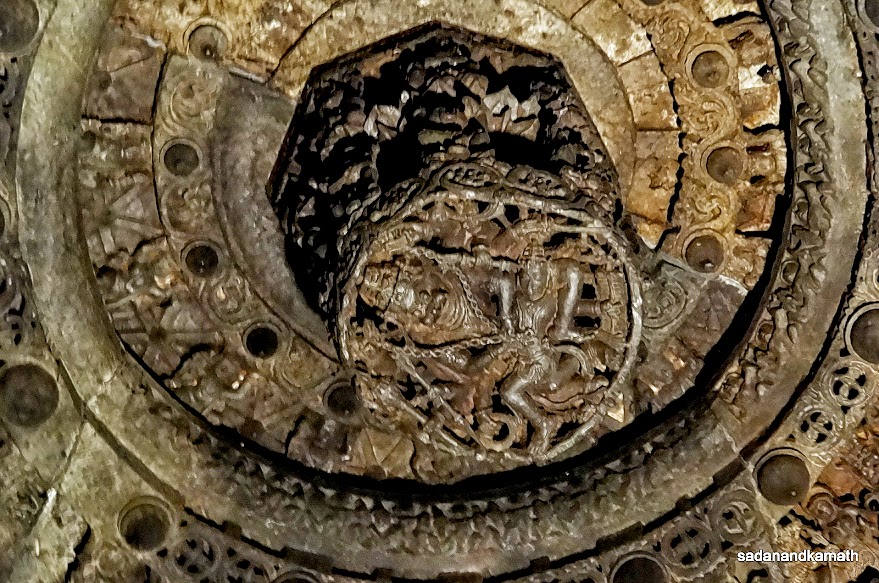
 
The central part of the ceiling of Mandap inside the temple. The protruding part of the delicate sculpture is that of Narasimha avatar.
 
There are a number of stone pillars in the Mandap, each being distinct from others both in terms of carvings and dimension.
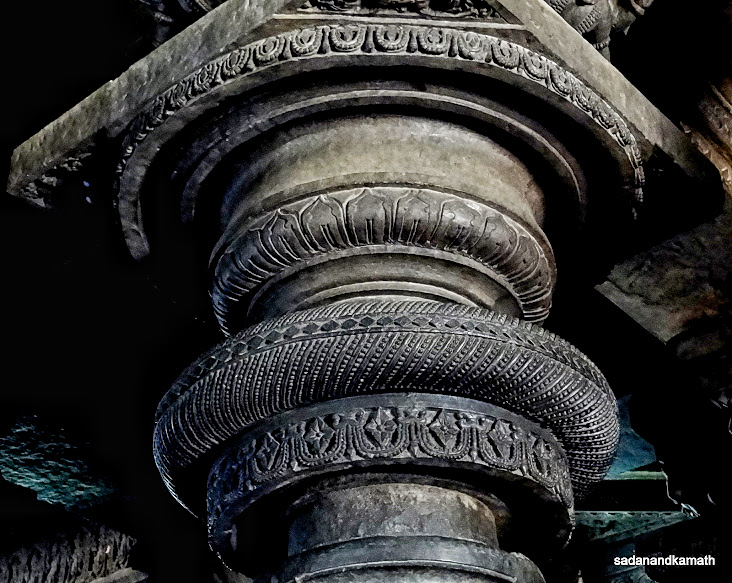
 
A close up of the stone carvings on one of the pillars of Mandap.
 
Close up of the arvings on another pillar of Mandap. The colour of the pillar has slight yellowish due to the light of the sodium lamp falling on it.
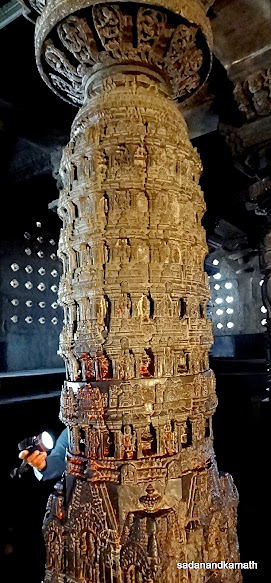
 
 
This pillar in the mandap is revered by the devotees as there sculptures of Narasimha. Hene it is also called as Narasimha Pillar.


Thursday, March 5, 2015

Two lesser known temples in the vicinity of Chikmagalur - February 2015

Eversince I passed through Chikmagalur as early as May 1966 from Kadur on our way to Mangalore, it had been my cherished desire to visit this hill town and spend a couple of days in tranquility. But I could not get any opportunity or occasion to visit the place until last month when we had to attend a marriage of one of our close relatives in Haveri. In fact, this occasion became a sort of family get together. So I and my wife along with my two brothers-in-law’s family planned a trip to Chikmagalur after the marriage.

We boarded the 7.OO a.m. Dharwad-Bangaluru Intercity Express at Haveri which reached Kadur around 11.OO a.m. We hired a Maruti Omni van from the Bus Stand which was about one k.m. from the railway station, for Chikmagalur drop (@Rs.800/-, 40 kms). The road to Chikmagalur was in good condition. It took about one hour to reach Chikmagalur. We checked in The Grand Krishna Hotel(@2000/- with breakfast) located about one km from the Bus Stand. We had lunch at the Hotel’s roof top restaurant called ‘The Spice’.The food was excellent.

After a short afternoon siesta, we strolled on M G Road which was a shopping area and also walked around the Bus Stand to scout for the hiring of a vehicle for the next day’s visit to Belagavi, Belur and Halebeedu. Later on, we decided to hire the vehicle from Hotel’s desk and negotiated directly with the travel agency which agreed @ Rs.2500/- for Innova for the whole day trip.
A part of the town as we entered Chikmagalur from Kadur.
 

The Grand Krishna Hotel where we stayed.


Kodandarama Temple, Hiremagalur
Next morning, after an excellent complimentary breakfast (coffee was excellent+) in the Hotel’s restaurant, we started our day’s trip at around 9.00 a.m. Our first stop was to be Belavadi for visiting Veer Narayana Temple. However, on a suggestion from our driver, we visited Kodandarama Temple located at Hiremagalur, about 5 kms from our Hotel. From the outside, the temple did not look architecturally impressive. However, once we entered through gopuram, we could get a feel that this temple must be as old as that of Hoysala period, probably belonging to 12th century AD.
 
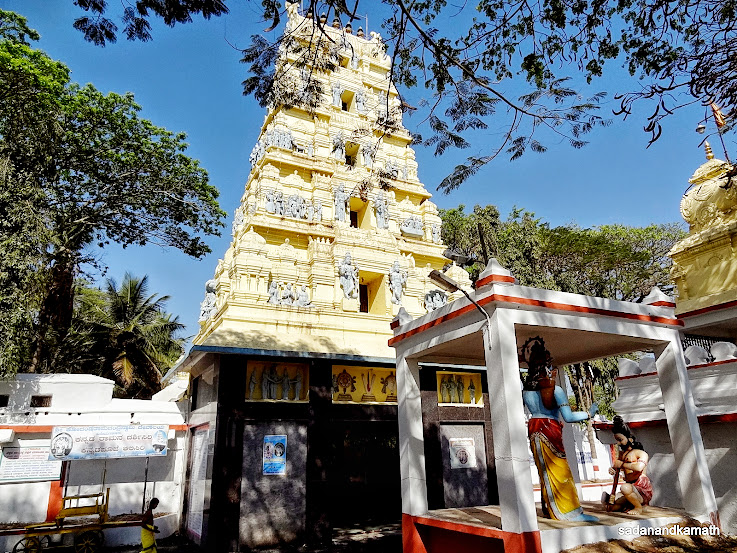
The entrance to the temple is through a gopuram. The main structure of the temple and the mandap appears to be architecturally close to the Hoysala style. However, the gopuram and the spire of the temple appear to be the later additions as the sculptures on them are not in tandem with sculptures on the temple walls. The idols in the sanctum sanctorum are of Ram, Laxman and Sita in shining black stone. Both Ram and Laxman hold bows on their left hands while holding arrows on the right hands. Since Lord Ram is holding Kodanda (the name of the bow), he is called Kodandarama.
 
In most of Ram temples, the idol of Sita is on the left of Lord Ram while idol Laxman is on his right. However, in this temple, Sita is standing on the right of Lord Ram and Laxman on his left. The legend says that this was the place where Lord Ram pacified an angry Parashuram whose pride got a beating when Lord Ram broke Lord Shiva’s bow during Sita Swayamvar which he had given to King Janak. After cooling down, Parashuram requested Lord Ram to enact the scene of his marriage to Sita whereupon Lord Ram stood with Sita to his right and Laxman to his left.
 
Since photography inside sanctum sanctorum was prohibited, I could not take the picture of the idols which in my view is one of the most beautiful idols I had seen in the temples. I had seen a very old photograph of the idols which showed intricate carvings on them.
 
Another feature of Kodandarama temple is that the priest, Shri Kannan, a Tamilian settled in Hiremagalur and a laureate in Kannada language, chants hymns in Kannada so that the local people in general understand the meaning of the hymns. Our driver told me that he is a TV personality and had received Karnataka State Government Award for chanting Sanskrit hymns in Kannada. When we visited the temple, Shri Kannan was already in sanctum sanctorum conducting pooja. After seeing us, he conducted Kumkum Archana Pooja for us, chanting hymns in Sanskrit since none of us understood Kannada. I was pleasantly surprised that after the end of the pooja, there was not even a subtle hint of the expectation of a ‘dakshina’ (donation) from us.
 
A few pictures of the temple are uploaded below.

Gopuram of Kodandarama temple, Hiremagalur.

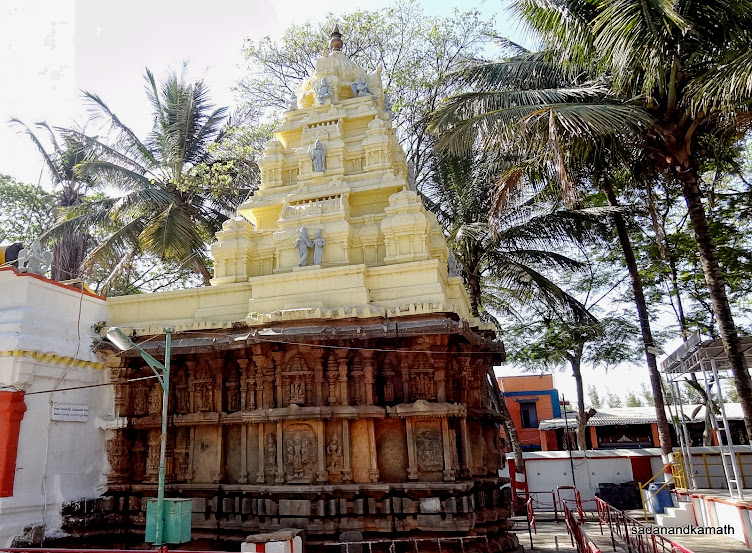
Kodandarama temple. The tower of the temple seems to be a later addition.
 
Sculptures on the outer wall of Kodandarama temple.
 
Sculpture of Yoga Narsimha on the outer wall of Kodandarama temple.

 
Chariot of Kodandarama temple.
 
Veer Narayana Temple, Belavadi
A drive of about 25 kms from Hiremagalur towards Halebeedu took us to a nondescript village called Belavadi which was our next stop for visiting Veer Narayana temple, a protected monument under Archaeological Survey of India.  
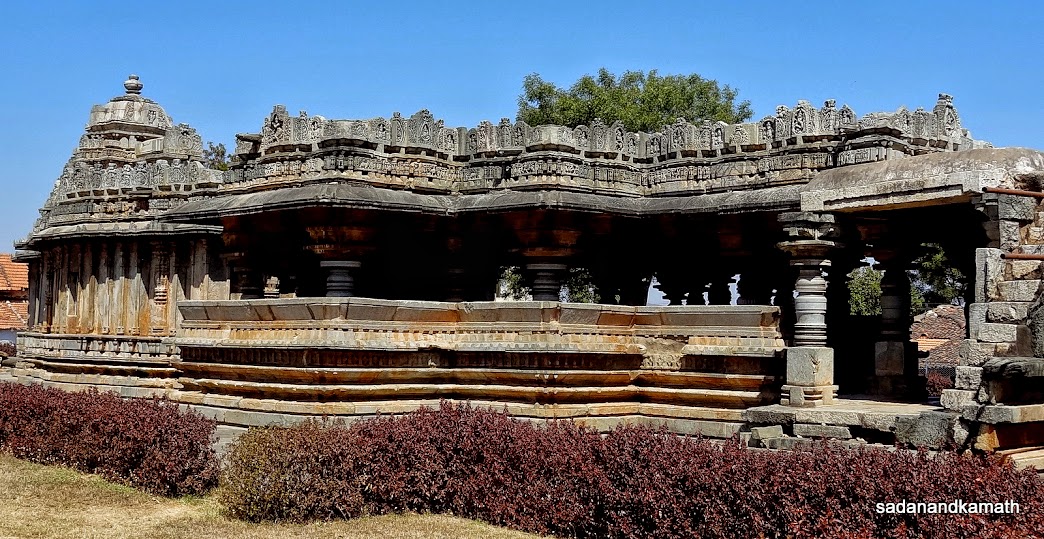
Veer Narayana is an uniquely built temple dating back to C.1200 AD. The temple was built during the reign of Hoysala King Veer Bhadra II. As we entered the outer mandap (hall) leading to the main shrine of Veer Narayana, there were intricately carved pillars of black stone,  some of which were shining like glass. At some places, ceilings were also intricately carved out of a single stone. The inner mandap had also intricately carved pillars but not as shining as that of the pillars of outer mandap.  
The main feature of this temple complex is that there are three temples adjoining mandaps. Two temples faced each other – one at the left is Venugopala temple facing north and the other one on the right facing south is that of Yoga Narsimha temple. The main temple facing east is  Veer Narayana temple. Hence this temple is also called as Trikuta temple.
A lot of efforts seem to  have gone to make all the idols of three temples more beautiful than the sculptures and carvings on the inner as well as outer walls of the temple. I felt that viewing these beautiful idols of Gods can make even an atheist to start admiring the God as a starting point for believing in God. Unfortunately, photography in the sanctum sanctorum of all the three temples is prohibited.
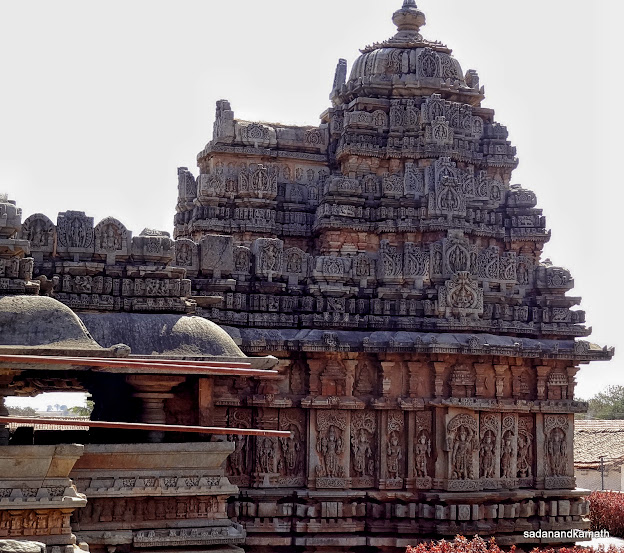
All the three towers of the temples have also been intricately carved having various sculptures of gods and people. The outer walls of the temples have both the sculptures as well as carvings mostly depicting the stories from Ramayan and Mahabharat. Some of the sculptures and carvings especially in the lower panels have been damaged. But those on the upper panels have remained more or less intact.
This is a live temple where a priest performs daily rituals both in the morning and evening.  It was the priest who gave us a brief history of the temple and revealed another uniqueness of the temple. From the sanctum sanctorum of Veer Narayana temple, one can see a straight path without any obstruction leading to the main entrance to the east. The distance could be about 100m. On March 21st and September 21st every year, if it is not a cloudy day, the morning sun rays directly falls on the idol of Veer Narayana.
Some of the pictures taken during the visit to the temple are uploaded below:
 

Entrance to Veer Narayana temple, Belavadi.
 
Front view of Veer Narayana temple complex.
 
 
Outer Mandap (hall) of the temple. Note the well carved shining pillars.
   
Close up of one of the well carved pillars of the outer mandap. 
 
Inner Mandap. At the far end is the sanctum sanctorum of Veer Narayana temple.

Domical ceiling of the outer mandap.
 
Intricate carving on the ceiling of the outer mandap.
 
Tower of Venugopala temple.
 
Tower of Yoga Narsimha temple.

Sculptures of gods on one of the outer wall of the temple.
 
Outside view of Outer mandap. 
 
Top of the outer mandap.
 
Carvings on the top of the outer madap.
 
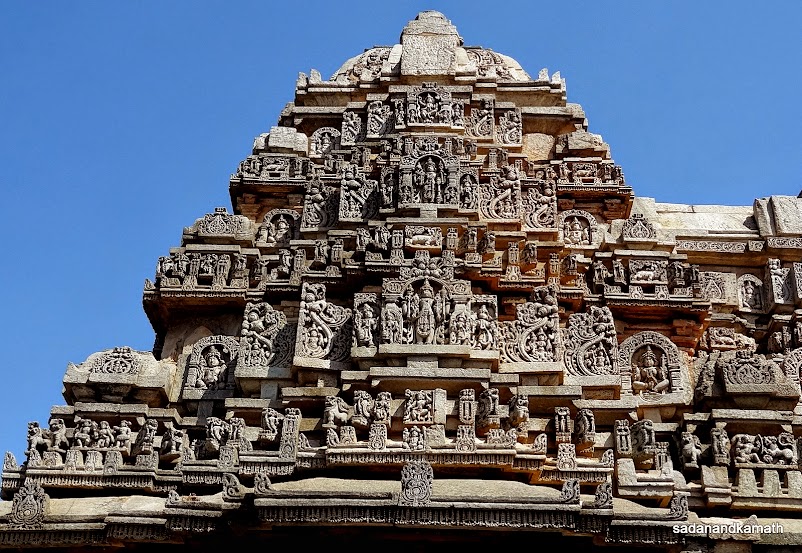
Carvings on one of the towers of the temple.
 
Sculptures of Gods on outer wall of the temple. I can recognise Lord Vishnu (second from left) and Yoga Narsimha (third from right).
From Belavadi, we proeeded to Halebeedu temple which I will cover in a separate post.