Wednesday, January 9, 2013

Khonoma - A Historical Nagaland Village : December 2011

Khonoma Village
During our five days of stay in Kohima, we had planned for a visit to typical Naga village. After checking out in the Internet and on a recommendation from a friend who spends most of his time in north-eastern states, we decided to visit Khonoma which is closer to Kohima  (20 kms) than other villages in Nagaland preferred by tourists.  A taxi was booked one day in advance for a day trip to Khonoma (Rs.1700/-).
 
When we got up early in the morning, we realised that there was some water problem in the hotel. The problem became acute as the time progressed and at last we had to manage with only hot water wash. After some time, the water supply completely stopped. Problem appears to be on account of non-functioning of water pumps as I could see from the window that a mechanic had been checking the water pump. After breakfast, we commenced our journey to Khonoma village at 8.30 a.m.
 
Earlier KS had a telephonic talk with Ms. Rovino who had a home stay arrangement in the village for providing a guide for a village walk in Khonoma and also for arranging vegetarian lunch for both of us after completion of the village walk. It was difficult get inpromtu vegetarian meals in the village as there were no hotels, restaurants or even a dabha.
 
We left our hotel around 8.30 a.m. in a hired taxi for Khonoma. After about 4 kms of drive on Kohima-Dimapur road, a diversion to the left  took us on a single lane road to Khonoma. The road was in a horrible condition with patholes till the outer gate of Khonoma village as the road widening work was in progress. It took almost 1 hour 45 minutes to cover a distance of 20 kms to Khonoma. I was feeling sorry for the taxi driver who had taken his newly bought Maruti Omni taxi on this road. However, the slow movement of our taxi gave us opportunity to view beautiful landscape - deep valleys skirted by thick forest cover. There were many memorials erected on the road sides as we reached the outskirt of Khonoma. We reached Khonoma around 10.00 a.m. We parked out car near the Baptist church and waited out guide to come. He came in 5 minutes and introduced himself to us who turned out to be Ms. Ravino's 71 year old father.
 

The 20 kms road journey to Khonoma village is very rough as it is a mud road having lots of potholes.

  
The stepped paddy fields in the midst of forest seen from the road to Khonoma village.
 
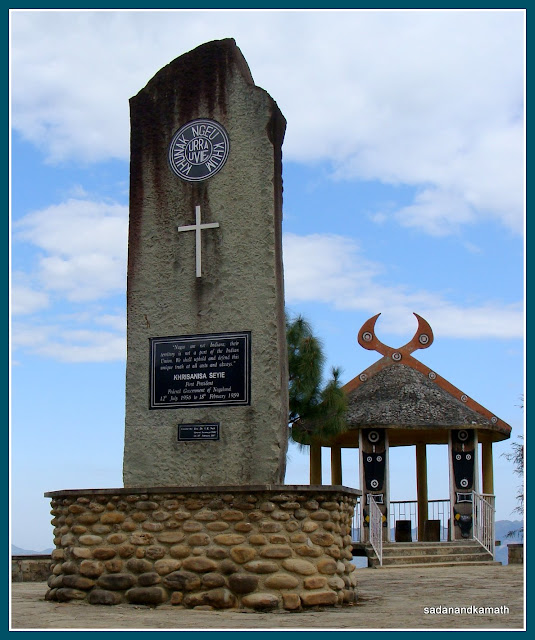
A memorial in honour of the first 'President of the Federal Government of Nagaland'. Behind the memorial is the View Point of the valley which is perched on a hanging rock.
  
A welcome arch to Khonoma village about 3 kms before the village.
 
Baptist Church, Khonoma village. The church is located at the juntion where the only two roads in the village meet.
 
We started our village walk with out guide by climbing a stone staircase just opposite the Baptist church. He took us to many historical places - Forts, memorials, murungs, shawl and basket  weaving places etc.  There are hundreds of memorials in the village erected in honour of those who laid down their lives fighting for Naga cause and of those who had contributed for the welfare of the village. The village walk took about 2 hours to complete. Being an old man, our guide was very knowledgeable about the evolution of this village to the present position. I could not believe that the village had 3 cell towers - Aircell, Airtel and BSNL. Apart from learning about  the contribution of the villagers in keeping the village green, what impressed me more about Khonoma village the cleaniness in the entire village. I have travelled to many villages across India but I saw the cleanest village in Khonoma.
 
The stone steps leading to the upper Khonoma village. Most of the historic places are in this part of the village.
 
The Stone door with typical Naga painting which was to be installed at the gate leading to upper Khonoma. There used to be a wooden carved door but that was replaced with this stone door. But it was so heavy that it could not be moved. So the stone door has been kept aside.
 
An Angami Naga man relaxing on the boundary of his home in Khonoma village
 
A part of the Khonoma village. The population of the village is around 3000 and almost all houses have tin roofs as against the traditional thatched roofs. This is on account of the fact that original traditional houses had been destroyed during war years  and new houses were built after the war ended.
 
Khonoma village on the left with stepped farms in the valley. More than 20 varieties of rice are grown in these fields surrounding the village.
 
A church located on the top of a hillock seen from the upper Khonoma village.
 
Khonoma village has a population of around 3000 mostly inhabited by Angami Naga tribe. It has a history of fighting Britishers in the 19th century and with Indian army in the late 50s. The village has two one-lane roads - the upper circular road and the lower circular road.  Almost all houses are built around these two roads. I can now understand as to why British army and later Indian army found it very hard to capture Khonoma. The village is located on a hillock surrounded by valleys from all sides. While the base of the valleys have stepped farm land, the upper sides of the valleys have dense cover of forests. So villager can see from the top any army movements and take positions accordingly to ambush the advancing soldiers. In case of emergency, the villagers could take shelters under the dense forest cover and frustrated the advancing soldiers with their guerrilla warfare. During those time, they used to live in the forest with wild apples, animals and birds as their food.
 
Earlier, the villagers sacrificed their lives fighting British forces and later the Indian forces for Naga cause. Now many of them have sacrificed their livelihood for the cause of keeping the village green and maintaining the ecological balance. The Village Council has completely banned log cutting and hunting animals and birds which is in force for more than 10 years now. It is gratifying to know that all villagers are cooperating in this regard.  
 
After completion of about two hours of walk around the village, we visited Ravino's house located on the other side of the Baptist church. We had a cup of tea and biscuits in his house before proceeding to community kitchen located about further 1 km from his house where our lunch was arranged. After the exploration of the surrounding places of the community kitchen, we returned for buffet lunch in the open air. The lunch menu had a good varieties of non-vegetarian food but on our request, Ravino had arranged some vegetarian dishes  like vegetable soup with bamboo shoots, rice, dal, red and white pumpkin mixed vegetables, boiled mustard leaves salad etc. The lunch costed us Rs.300/- per head. The guide charge was Rs.300/-. 
 
A part of Khonoma village seen from the Fort. The circular place (top left) is the meeting place for the villagers.
 
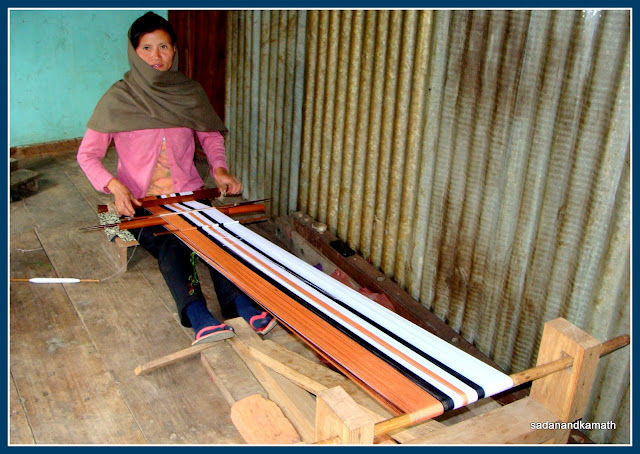
A lady weaving a woolen shawl in  her Khonoma house.
 
A basket weaver
 
We visited the house of Mr Anguile,  the two time National award winning basket weaver. Here he is seen almost completing the basket weaving.
 
The history of the Khonoma Fort inscribed on a stone plaque near the entrance to the Fort.
 
In 1870's war with Nagas, British forces entered Khonoma village (left foreground) from this valley.
 
Lower circular road passing through the lower Khonoma village.
 
One of the traditional Morungs ( bachelors' dormitory).  Morungs play a vital role in Naga Society. It serves as a learning institute where young boys  are passed on the traditional beliefs and customs from one generation to another.  Of course with the advent of schools, this convention is slowly going into background and it is now being used more like a recreational club.
 
Nagas consider hanging of heads of the hunted animals at the entrance to their houses as 'trophies'. The more the trophies, the higher the status of the Nagas in the society. In this house, heads of animals such as monkeys, deers, Mithun ( a kind of bison) and wild boars can be seen.
 
A stone in owl shape near Community Kitchen is said to drive away the evil spirit from Khonoma.
 
The house at the right is the Khonoma Village Council Office. At left is a private resident.
 
A picturesque ground  in Khonoma village, surrounded on the three sides by dense forest.
 
After lunch we sent for a stroll on a big ground behind the community kitchen. The pleasant weather made the stroll enjoyable. Around 3.00 p.m., we took leave of our guide and Ms. Ravino and started our return journey leaving behind the  memory of a beautiful and historical village Khonoma. Perhaps staying overnight in the village would have given some more insights about the village.
 
For more pictures of Khonoma village see photo album.


Friday, January 4, 2013

Photoblog of Trip to Mysore and Somnathpur - February 2012

We visited Bangaluru (earlier Bangalore) for attending a family function in February 2012. I had requested my host family that having come to Bangaluru, I would like to visit Mysore especially to see Keshava temple carvings in Somnathapur. I had heard a lot about the intricate temple carvings through some travel related articles and this time I did not wish to miss this opportunity. My host family not only agreed to accompany us, he made it a part of a family gathering by hosting the visit.

After the end of our engagements in Bangaluru, we started our journey at about 4.00 p.m.  by a hired Qualis for Mysore. After a 45 minutes coffee break on the Bangaluru-Mysore highway, we reached Mysore around 7.30 p.m. We checked in   a pre-booked guest house which was more like a home stay. The guest house belonged to a company where my host was working. The guest house was posh and located at a peaceful area not far away from the city centre. There was a cook attached to the guest house who prepared breakfast and meals as per our requirements. 

Day-1 : Somnathpur- Srirangpatnam-Mysore Palace-Brindavan Garden

After a heavy breakfast in the guest house, we started our journey for Somnathpur at around 10.00 a.m. The road journey (30 kms) was not as bad as  anticipated by us on the basis of the experiences of earlier travellers on this road. The star shaped temple is dedicated to Prasanna Chennakeshava ( Happy and handsome Keshava) an incarnation of Lord Vishnu. The stone inscriptions at the entrance of the temple give the history of the temple. The temple was constructed in 1268 by Somanatha Dandanayaka, a commander in the army of Hoysala king Narsimha-III. Hence the name Somnathpur is given for the village.

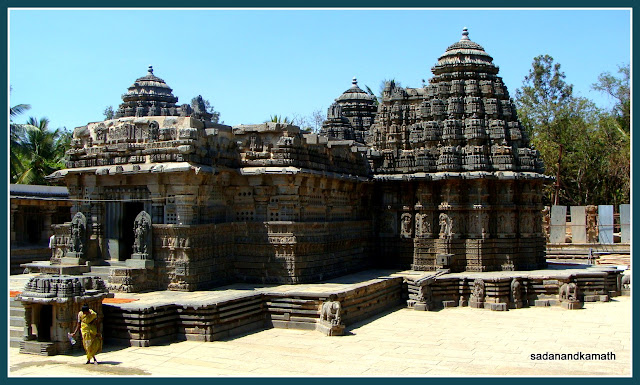
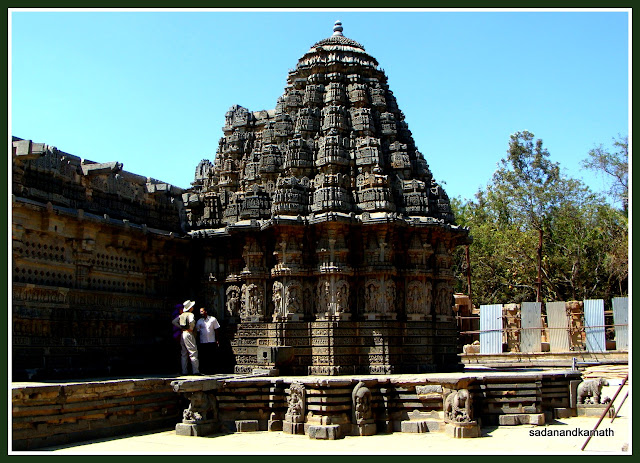
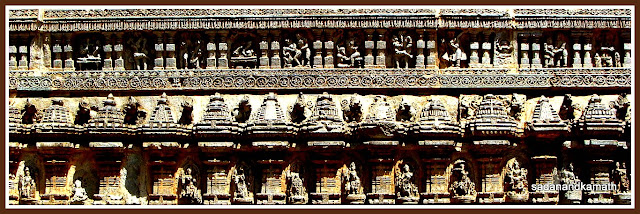
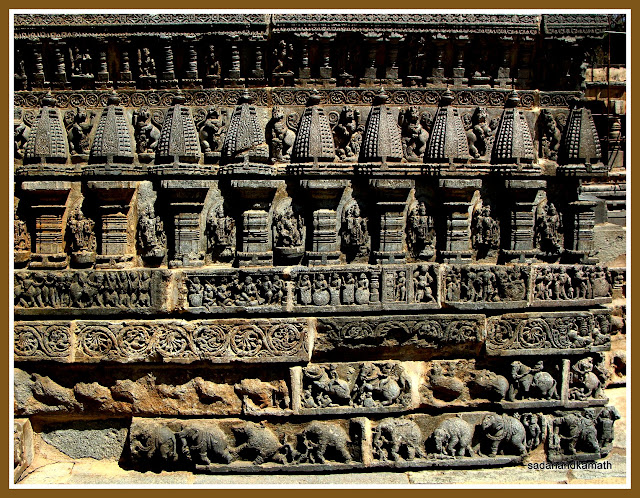
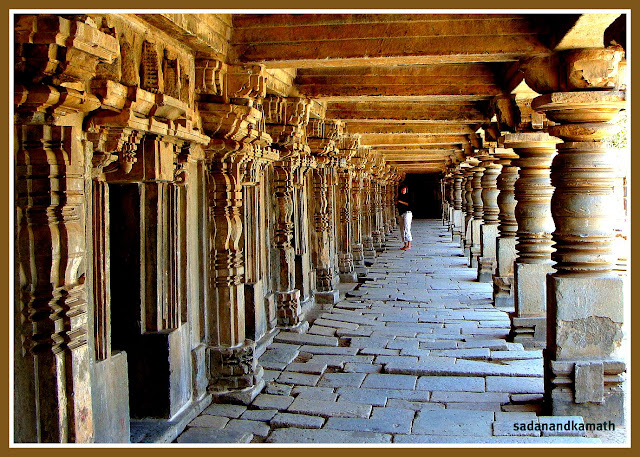
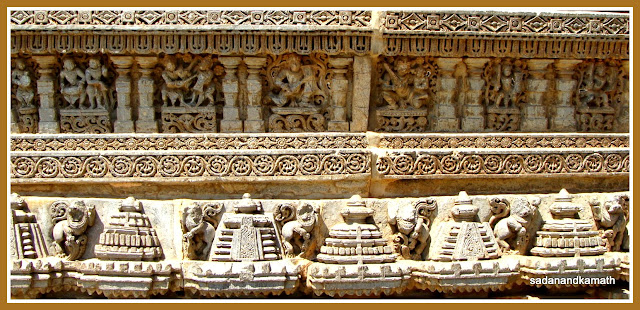
The temple is enclosed from all the sides by a high wall. The temple is based on a high platform. The lower panels of the platform have sculpted processions of elephants followed by sculpted horsemen above it and then the band of foliage in the next. The upper moldings have carvings depicting scenes from Hindu mythology. I have seen almost similar type of architectures of platforms in Belur and Halebidu temples. The ceiling of the main hall is supported by lathe turned pillars probably of granite stones. Ceiling is intricately decorated with carvings. There are three temples within the enclosure of the main hall. The  main idol of Keshava is missing while other two idols of Janardan and Venugopal are still intact. Architecturally, everything about the temple appears symmetrical – be the shape of vimanas (domes), panel horizontal carvings on the base and vertical carvings on the temple domes. Another interesting point about the temple carving is that no place has been left out in the temple structures without carvings.

We spend about one hour in the temple complex. Despite being in the midst of the winter, the day was quite warm and the sun was very strong. I would advise to those interested in doing photography in the temple complex to consider visiting the temple say before 9.00 a.m. or after 4.00 p.m. to get the lighter sunrays for photography.

After Somnathpur, our next place to visit was Srirangapatnam. I have visited this place a couple of times in 70s and 90s. This is a live temple requiring us to e stand in the queue for ‘darshan’ of Srirangapatna. After lunch at Dasaprakasha, we proceeded to Mysore Palace which I had seen in my earlier visits. The camera, mobiles are not allowed inside the palace. However, one can take pictures from outside the palace.
It was almost 3.30 p.m. when we ended our round of the palace including the museum. We returned to the guest house for some rest. After tea/coffee in the evening, we commenced our journey to Brindavan Garden. We all had seen the Garden many years back but none of us has ever seen the garden and fountains under floodlight. So we had planned to visit the Garden only after sunset. It took almost one hour to reach Brindavan Garden gate. There were large number of cars and buses already parked giving an estimation of the number of people already inside the Garden. After buying entry tickets, we entered the Garden. A series of fountains were already flooded with lights which looked beautiful. Our main interest was to reach the last fountain which was a musical fountain playing on the tunes of Hindi and Kannad film songs. The musical fountain show ended with ‘Sare jahan se achhaa Hindustan hamaara’ song which, I would say, was the highlight of the musical fountain show. We returned to our guest house at around 9.30 p.m. and after dinner followed by some chit chat, we retired for the day. 

Day-2 : Chamundi Hills-Jagan Mohan Palace-Bangaluru

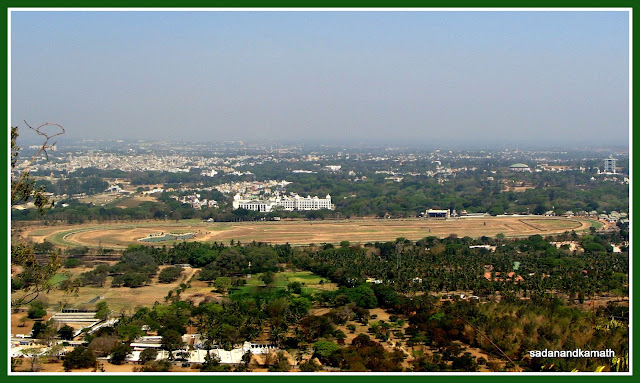
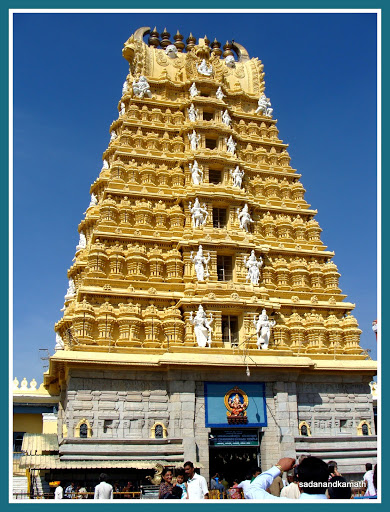
After breakfast, we commenced our journey to Chamundi Hills for visiting the Chamundeshwari temple (13 kms). There was no rush at the temple and our ‘darshan’ was smooth. Compared with my earlier visits, the surroundings of the temple has been kept very clean. The views of Mysore city and race course from the road to Chamundi Hills look very good. On our way back, we visited Jagan Mohan Place art gallery and spent an hour or so to see the paintings and other historical items kept on two floors of the palace. We returned to the guest house for lunch and after taking rest for a couple of hours, we commenced our return journey to Bangaluru thus ending a short and satisfying visit to Mysore and Somnathpur.

Some of the pictures taken during the journey are posted below with captions.
The pictures start with places visited in Mysore and then to Somnathpur temple. 


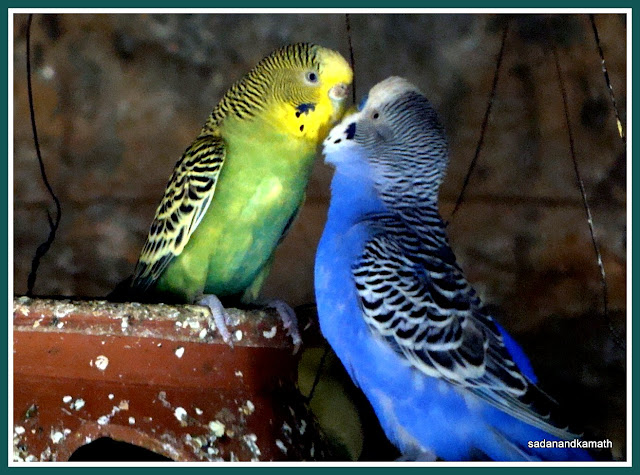
Love birds at one of the restaurants near Ramnagar on Bangalore- Mysore Highway.

Our guest house in Mysore where we were put up the first floor

On way to Srirangapatna

The main gopuram of Sri Ranganathaswami temple, Srirangapatana near Mysore

Idols of some of the Vishnu avatars on the top of the main entrance to Sri Ranganathaswamy temple

Vishnu Dashavatars - Narasimha Avatar

K R Circle, Mysore

Mysore Palace complex (Mobile upload)

Mysore Palace seen from the gate (Mobile upload)

Brindavan Garden in the night.

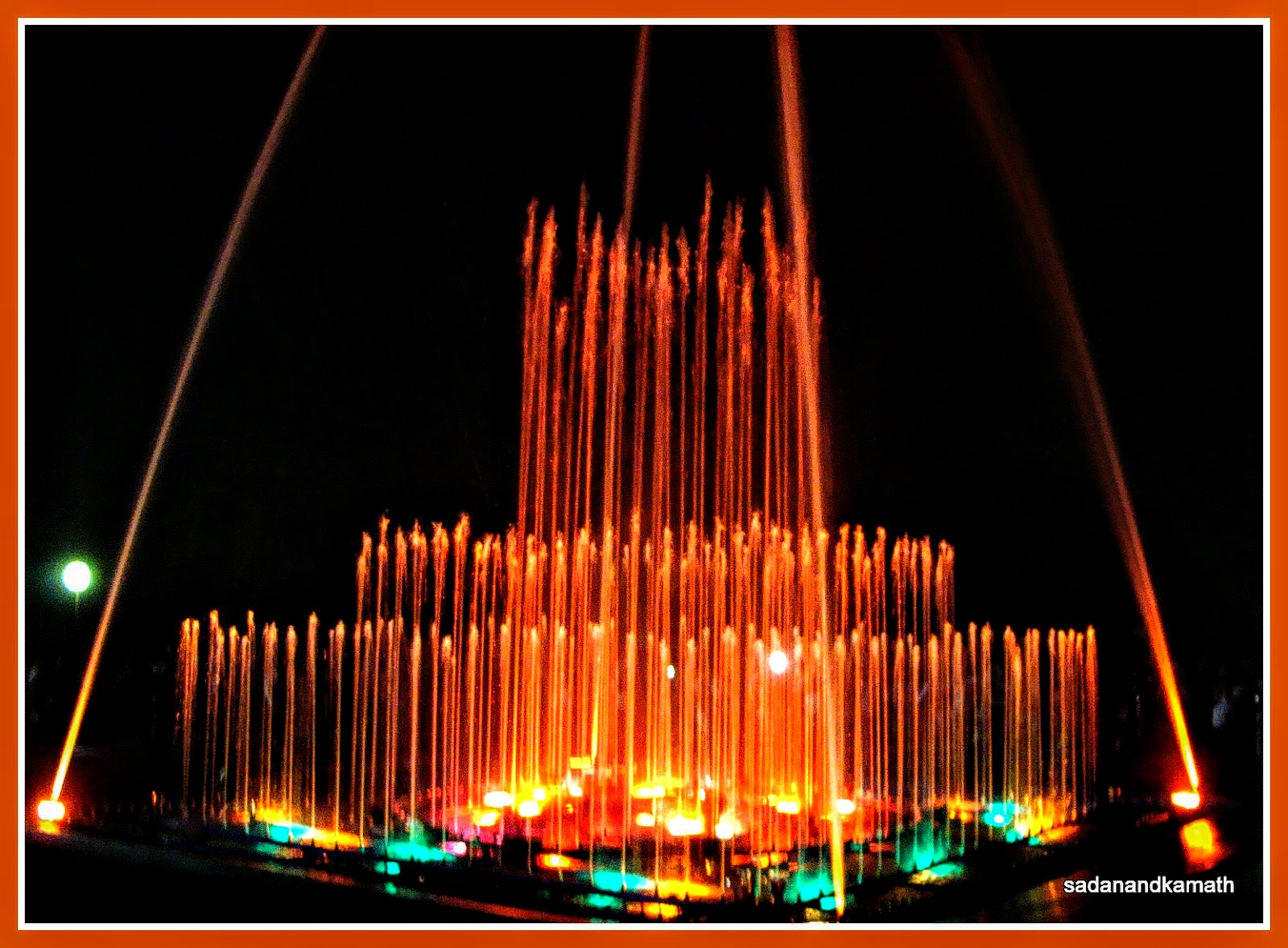
Musical fountains just before the end of the song 'saare jahan se achchha hindustaan hamara'.


Lighted fountains in Brindavan Garden.

A giant Nandi on the way to Chamundeshwari temple

View of the Mysore Race Course from the road to Chamundeshwari temple.

Statue of Mahisasura - Chamundi Hills

Gopuram of Chamundeshwari Temple.

A tree with wide spread over branches in the Jagan Mohan Palace complex.

Jaganmohan Palace, Mysore. Behind the Palace is the Art Gallery.

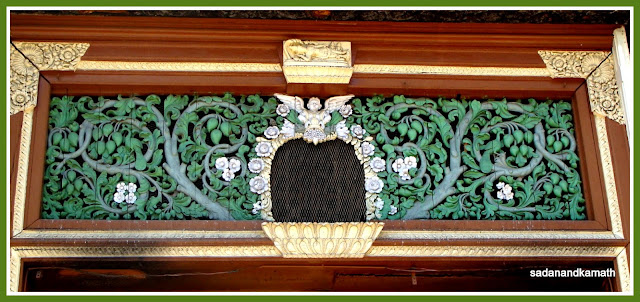
Coloured wood carvings of Mango tree on one of the main door top of Jagan Mohan Palace

Art Gallery of Jagan Mohan Palace.

Appears to be Buddha's sculpture kept outside the Keshava temple complex, Somnathapur.

The east facing main gate of Keshava temple, Somnathapur. The temple was built by Hoysala dynasty general Somnatha during the reign of King Narshimha-III in 1268 AD.

Stone plaque in Kannada language inside the main gate pavilion of Keshava temple.

Keshava temple view from the main gate.

Front view of the temple as seen from the entrance.

Left side view of the temple as seen from the entrance.

Right side view of the temple as seen from the entrance

The right side dome of the subsidiary temple of Kehsava temple.

The back side view of the central dome of Keshava temple. In the entire temple, hardly any space is left without carvings.

A close up of a top of the dome.

One of the two dwarpals of the Keshava temple.

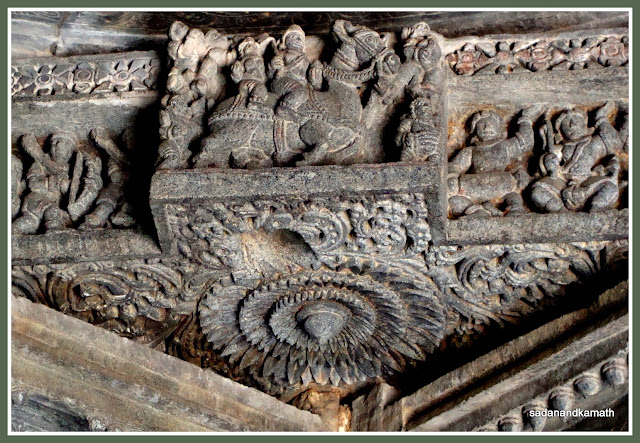
The intricately carved ceiling inside Keshava temple.
The sanctum  sanctorum of the Main Keshava temple
The idol of Keshava inside the main temple

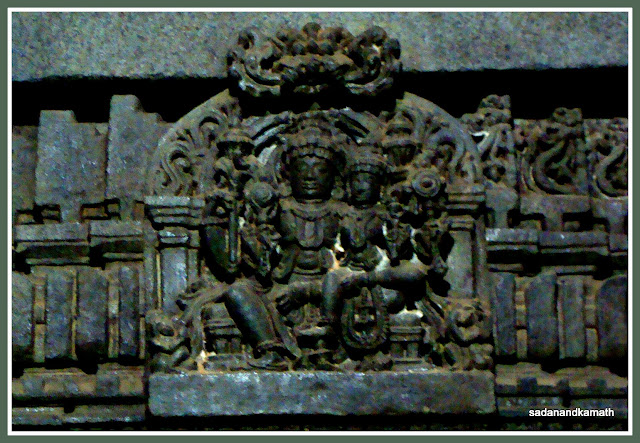
Vishnu with Laxmi

Carved ceiling of  sanctum sanctorum of Keshava temple

Panel carvings on the base and pillar carvings above the base at the outer wall of Keshava temple.

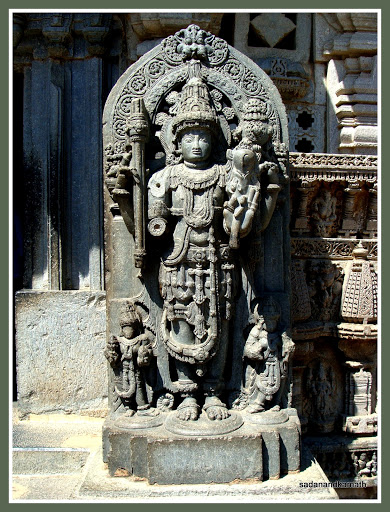
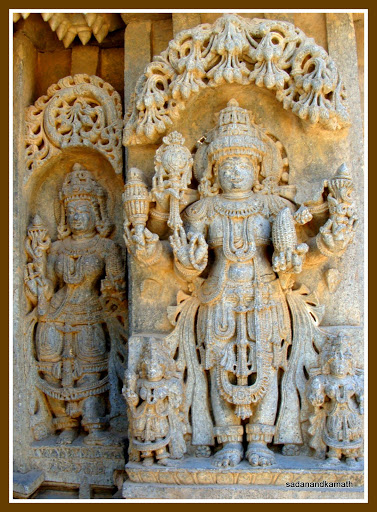
Image of Vishnu on the left

Image of Vishnu at the outer wall of the temple

Image of a lady carrying fruit in the outer wall of the temple

The carvings on the panels of the outer wall surface of Keshava temple. Generally, the lowest panels will have elephants as symbol of taking on weight of the temple

Outer wall surface carvings of Keshava temple. The continuation of these carvings in the next picture.

The continuation of the outer wall surface carvings from the previous picture.

The close up of the carvings of the outer walls of Keshava temple. On the top is the erotic carvings.


Carvings on the outer walls of the Keshava temple

One of several celestial elephants holding up the temple platform. Each such elephant is in different stance.

The walkway path close to the temple boundary has sanctums for subsidiary temples but at present they are empty

The other side of the walkway path with sanctums of subsidiary temples

Image of Vishnu in relaxing pose with the images of a drummer on the left and a woman carrying fruits on the right on the outwall surface of the temple.

Dancing Ganesh on the outer wall of the temple

Carvings of the musicians with musical instruments on the upper panel of outer wall of the temple

Picture of the main entrance pavilion from the Keshava temple