I have not been able
to undertake any trek during the last about 2 years due to Covid-19 protocols.
The planned trek to Mardi Himal in Nepal in April 2020 had to be cancelled for
the same reason. It was only after some relaxations in Covid-19 guidelines
especially for the travel, I could make a short family trip to Panchagani in
February 2021. However, with the
emergence of the second wave of Covid-19 sometime in March 2021, once again, our
mobility got severally restricted. It was only after September 2021 a gradual
relaxation in Covid-19 guidelines made it possible to plan for a short family
trip somewhere in coastal Maharashtra after Diwali.
We chose Diveagar in
Raigad district as the base for the stay as the place has village atmosphere away
from the hustle bustle of tourists. At the same time, this place has almost all the facilities that are expected by the tourists. The trip
was meant to be more of a relaxation in a different setting and less of the
sight-seeing. So, no detailed itinerary was planned except that we would leave for
Diveagar on the morning of November 11th by car and return home by the evening
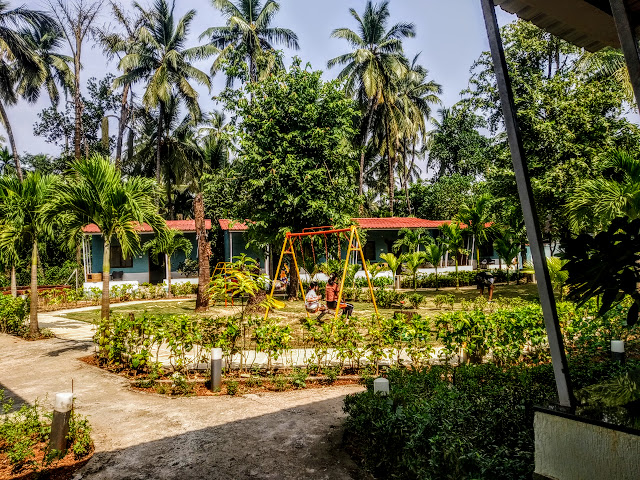
of November 14th. We pre-booked Betelnut Resort located within the walking
distance from Diveagar beach.
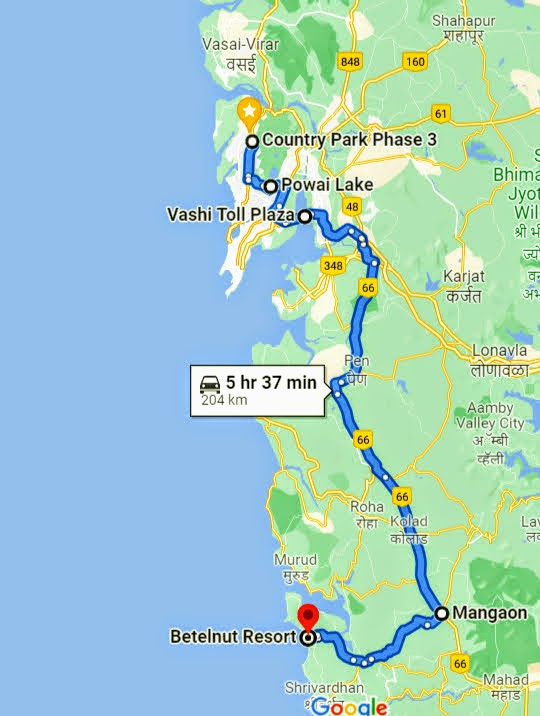
Our driving route from Borivali to Diveagar
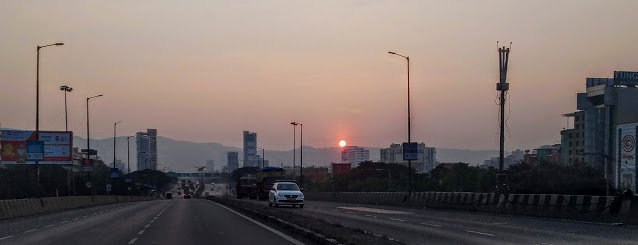
Sunrise just after Vashi Toll Plaza.
We left home in
Borivali at around 6.00 AM and stopped for the breakfast at Hotel Kshanbhar
Vishraanti at Chinchvan on Panvel-Goa highway (NH-66) near Karnala Bird Sanctuary.
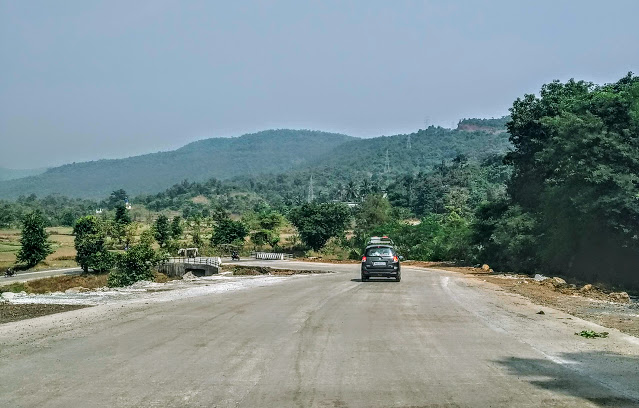
It was, more or less a smooth driving up to Wadkal by-pass. Thereafter, the
road condition was average up to Nagothane. From Nagothane there were long
patches of bad road condition up to Mangaon. From here, we took Mangaon-Mhasla
road (SH-97) which was a wide two-lane concretized road. We reached Betelnut
Resort by 12.30 PM. We checked in and ordered for Konkani Thali lunches in the
Resort’s restaurant. The food quality was very good. For the next 3 days we had
lunch and dinner at the Resort's restaurant only, except for the last day when we had
lunch outside in a Khanawal.
A 'U' turn on Mangaon-Mhasla cemented road.
Betelnut Resort, Diveagar.
Post-afternoon siesta,
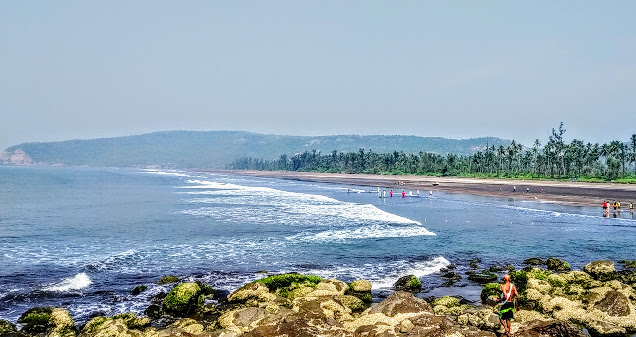
a leisurely 15-minute walk took us to the Diveagar beach. Fortunately, the
beach was not crowded. The sea-waves were gentle. We spent about an hour at the
beach, some of us plunging into sea bath. After the sunset, we returned to the
Resort.
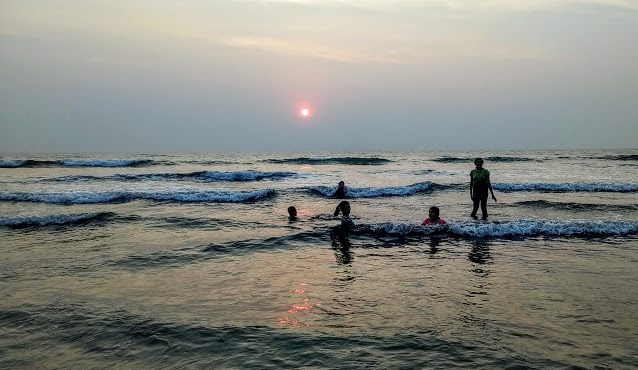
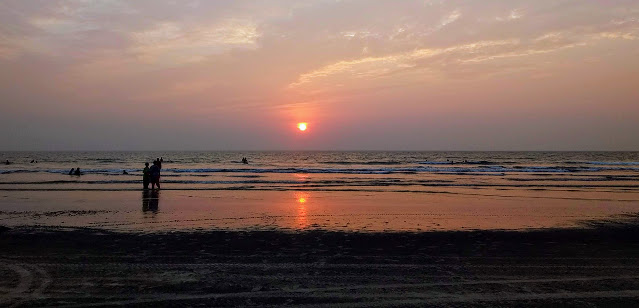
Sun is about to set in at Diveagar beach,
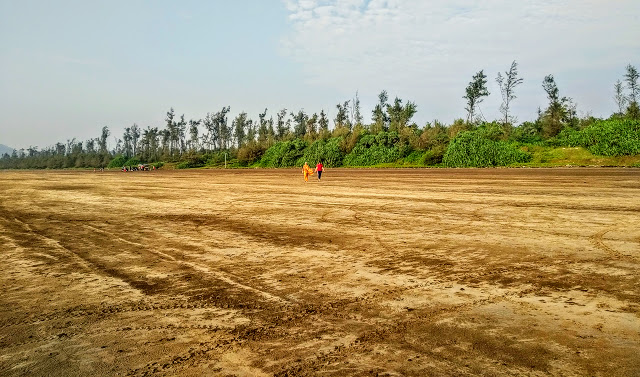
The entire Diveagar beach to ourselves.
Day-2: Visit to Harihareshwar
Driving route to Harihareshwar.
After a leisure
breakfast, we drove south of Diveagar on a single lane road. The road condition
was miserable in most of the journey. Hence, it took more than an hour to reach
Harihareshwar temple. There was ample parking space outside the temple complex - of course with a parking fee of Rs.50/- for 4 hours. The temple was not crowded at all. We finished the darshan in 5 minutes and
spent about half-an hour in the temple complex to enjoy the view of the
sea-shore and for some photo shoots.
Next, we explored the Harihareshwar
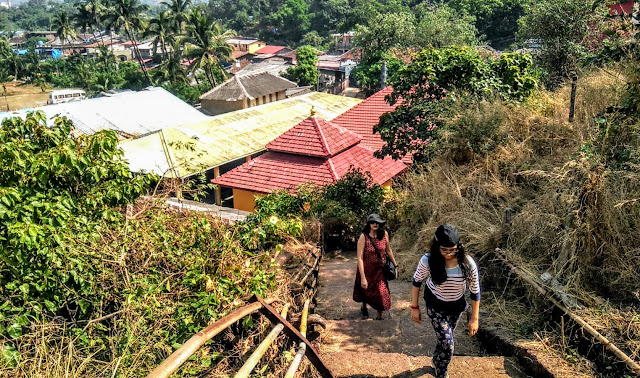
temple parikrama route which starts from the back side of the temple with a climb on stone steps to reach the top of the hill. From here, one can have a
nice view of Harihareshwar temple as well as the village. After some level
walk over the cemented path on the hill, the 75 odd rock-cut steps on the right side goes down to
the sea-shore. It is a narrow path
between two hills known as Ganesh Gully. It was a challenging one for the
senior citizens as railings on the rock stairs had completely collapsed.
Once down to the sea-shore,
it is a level walk on rocky surface skirted on one side by Arabian Sea and hills
on the other side. We spent about 30 minutes exploring the natural rock carvings on the hillocks and also some photo shoots. We also saw some dolphins swimming close to the shore but they did not oblige us with their skills of jumping out of water. This parikrama path is dangerous during high tides as tidal waves hit
the hillocks. Hence parikrama on this part is not allowed during the high tide periods.
We completed the parikrama by 12 noon and started our return journey to the
Resort. After lunch at the Resort’s restaurant, it was a relaxation time with
some of us taking the afternoon nap.
A few of the pictures
taken in Harihareshwar are uploaded below:
View from Harihareshwar temple complex.
Starting the Harihareshwar temple parikrama from the backside of the temple.
This is 75 odd parikrama step from the hill top to the base of the sea shore.
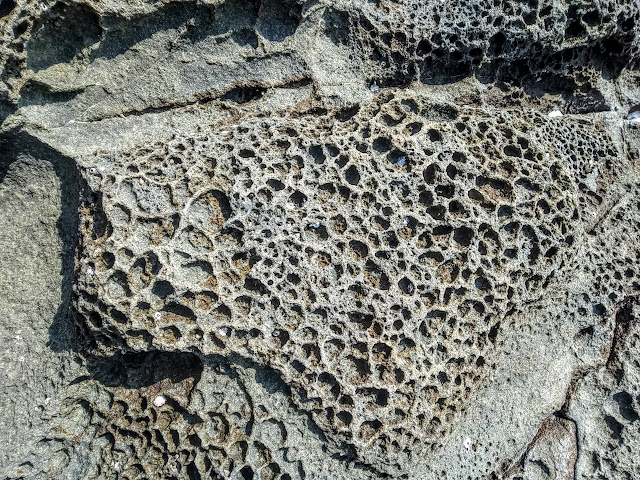
The 'design' on the rocky surface caused by the constant tidal waves of Arabian Sea flowing over it.
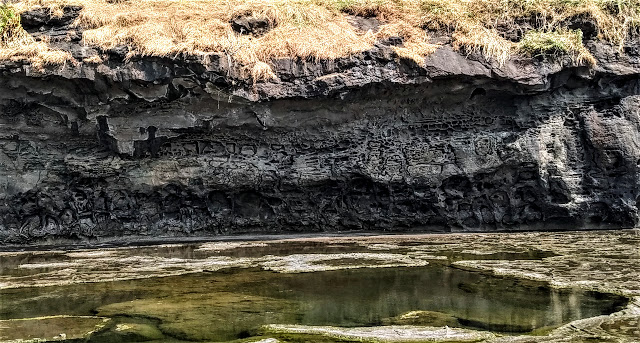
Natural rock carvings on Harihareshwar parikrama route due to constant hitting of tidal waves from Arabian Sea. On the rocky surface is one of the many mini ponds seen on the parikrama path
On Harihareshwar Parikrama path which is from this point all along the sea-shore. During high tide, the rocky surface goes under water about 4-5 feet.
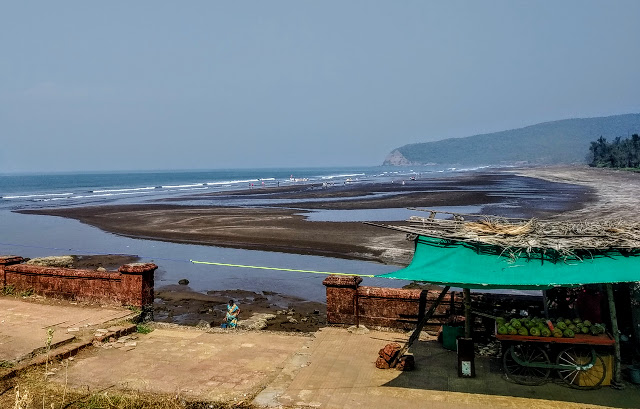
Harihareshwar beach seen from the parikrama route.
After the evening
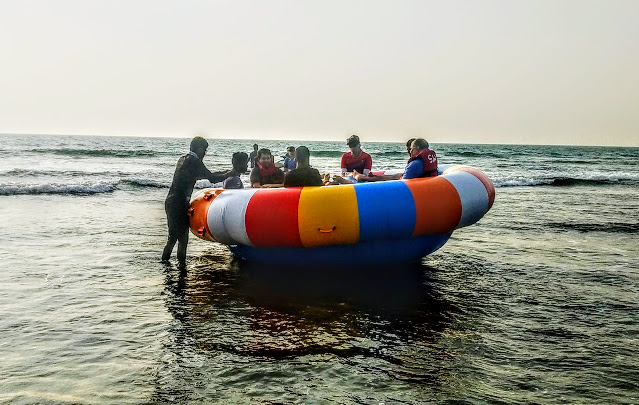
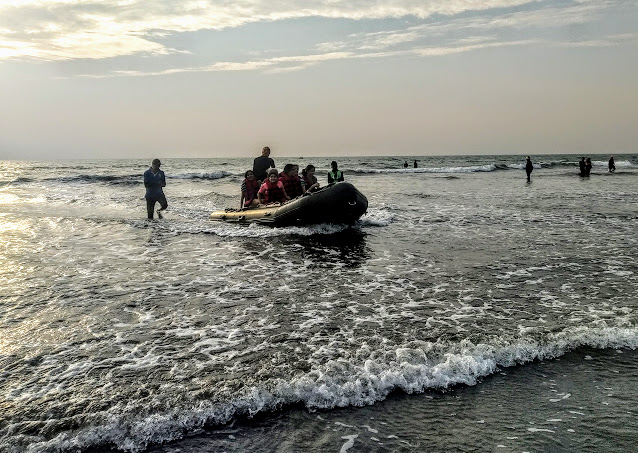
tea/coffee, we walked to Diveagar beach, this time for the water-sport activities.
Children were interested in Twist boat ride in which senior citizens were not
allowed. So, we took family boat ride. After completion of water sport activities,
some of us got tempted to go for the sea bath. After the sunset, we walked
backed to our Resort.
Walking on the Diveagar beach in the evening.
On the Twist boat ride.
On the family boat ride.
Sun is about to set in at Diveagar beach for the day.
Day-3: Visit to Murud-Janjira Fort
After bed-tea at 7.00
AM, I along with my son went for a morning walk on Diveagar beach to explore
the northern side of the beach. We were pleasantly surprised that there were
many morning walkers on the beach. We walked for about 30 minutes on the
northern side of the beach which ended at a point where a back-water creek
separated the beach from the hillock on the other side. The length of Diveagar beach is 4.5 kms. We must have walked at least 2 kms. During the walk, we witnessed the
sunrise and watched hundreds of sea-gulls. November-December are the months during which sea-gulls migrate mostly from Siberia to Indian coasts for breeding. We returned to our Resort just in time for a breakfast.
Walking pathway to Diveagar beach from Betelnut Resort
Sunrise through Suru tress over Diveagar beach.
After the breakfast,
we commenced our journey at 09.30 AM to explore Murud-Janjira Fort. The Fort
was opened for the tourists only about a fortnight back after further
relaxations in Covid-19 guidelines. Our first part of the journey was to reach
Dighi Jetty which was about 14 kms from our Resort. The driving was smooth on
the cemented road. We reached Dighi by 10.00 AM. We parked the car near the Jetty.
From Dighi Jetty, there
are two options to reach Murud-Janjira Fort. The first route will drop the
passengers on Agardanda Jetty on a 20-minutes boat ride. The boat can accommodate
about 12 cars and the equal numbers of two-wheelers. From Agardanda jetty, Rajapuri
Jetty is about 5-km drive from where another boat ride of about 2-kms takes the
passengers at the gate of Murud-Janjira Fort. This option is mainly for those
who wish to do Murud sight-seeing or move further north to visit other tourist places like Kashid beach.
The second option is
to park the car at Dighi Jetty and take a 30-minute boat ride direct to Murud-Janjira
Fort. We opted for this option. The boat departs for Murud-Janjira Fort every
30 minutes. Luckily for us, the boat was already waiting to fill the passengers
to its full capacity of 40 passengers. The cost of ferry ticket is Rs.116/- per
head inclusive of the return journey. The boat ride was smooth by-passing Dighi
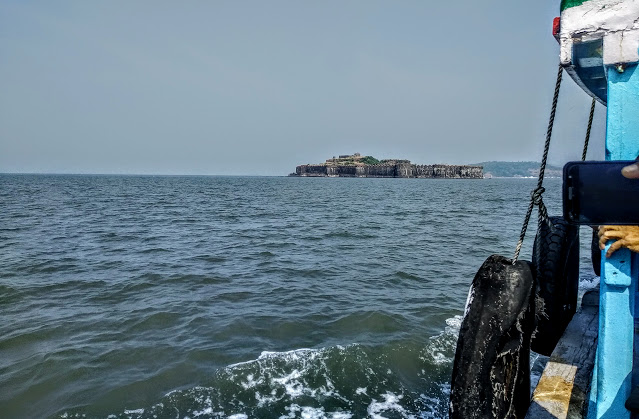
Port. After about 15-minute ride, Fort became visible. Just about 200m from the
gate of the Fort, passengers were transferred to a small boat which took us
up to the stairs of the Fort’s gate.
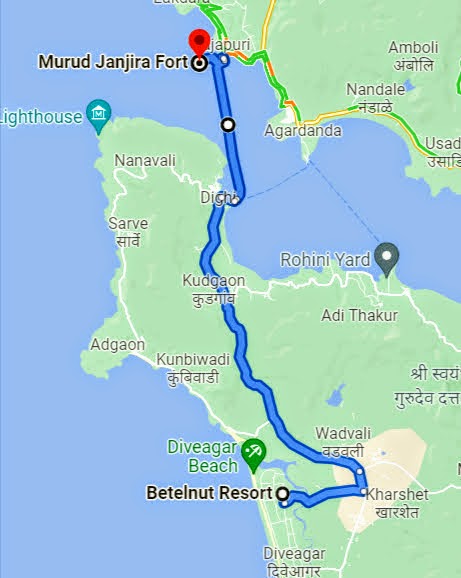
Driving route from Betelnut Resort to Dighi Jetty.
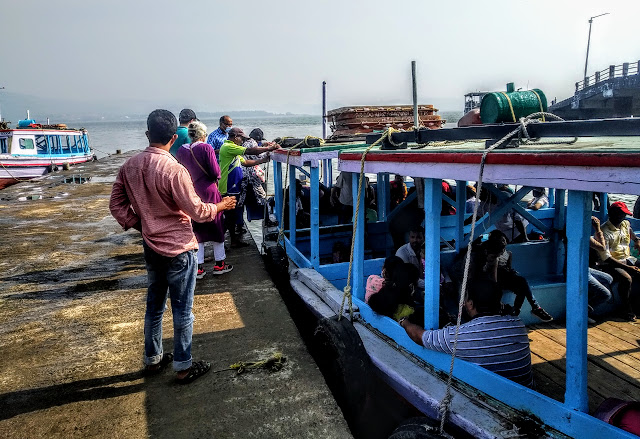
Boarding the boat at Dighi Jetty for Murud-Janjira Fort.
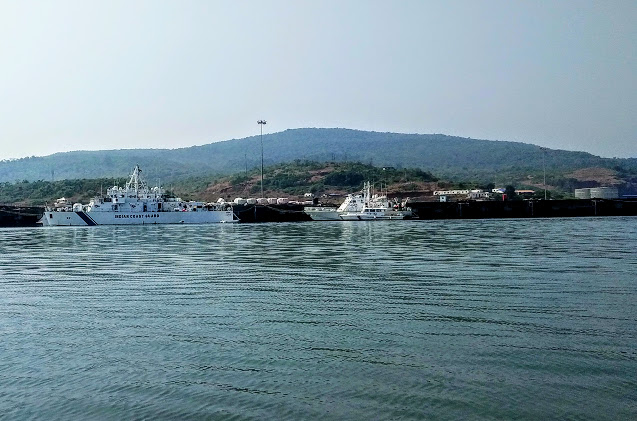
View of Dighi Port from the boat ride.
First glimpse of Murud-Janjira Fort from the boat ride.
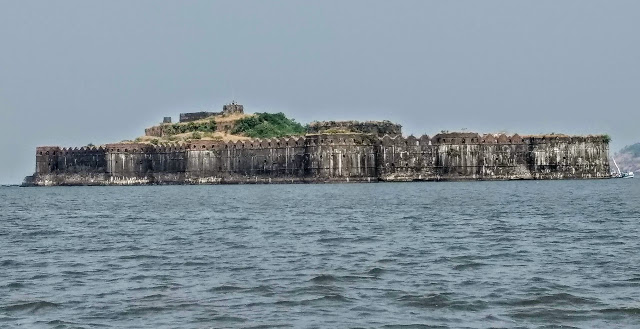
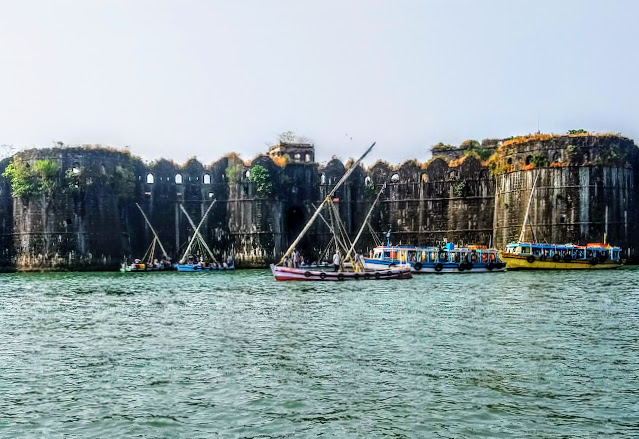
A closer view of Murud-Janjira Fort from the boat ride.
At this point passengers were transferred to small boat.
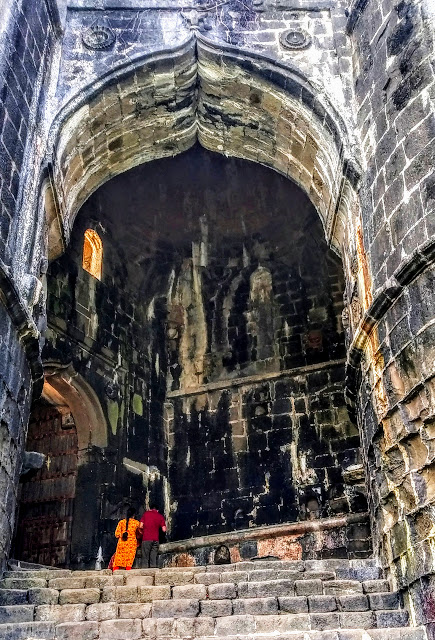
The main gate of Murud-Janjira Fort.
Murud-Janjira Fort is
spread over 22 acres of an island in the Arabian Sea. The word ‘Janjira’ seems
to be derived from Arabic word ‘Jajira’ which means island. According to a
guide on our small boat, a wooden boundary wall on the island was constructed sometime
in 16th Century by a Koli Chief, Rajaram Patil who himself declared
as the King of the Island. The place was captured by a commander of the Ahmednagar Sultanat. Later, Malik Ambar, the prime minister in the Ahmednagar Sultanat who was a
Siddi from East Africa started construction of the Fort which took about 22 years to
complete. Later, Siddis declared Janjira as an independent State which remained so until 1947 when it joined the Union of India.
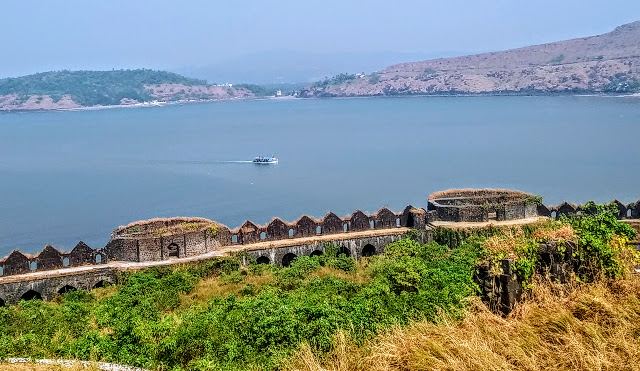
The Fort has 19
rounded bastions on which cannons were kept to ward off the attackers. The main
gate on the eastern side was constructed in such a manner that it was not
visible until one reached about 12 meters away from the gate. Inside the Fort,
there are two sweet water ponds which never get dry. There were granaries to
store the food grains and other essential items to last for a year. The strong
fortification and the availability of drinking water and food grains all
through the year inside the Fort made it difficult for Marathas, Portuguese and Britishers to conquer the Fort. Chatrpati Shivaji Maharaj decided to construct another Sea-Fort known as Padmadurg Fort, about 5 kms north
of Murud-Janjira Fort. He entrusted this work to Sambhaji to enable Marathas to launch the counter-attack
on Siddis from the Fort. However, the construction remained incomplete after
the death of Sambhaji.
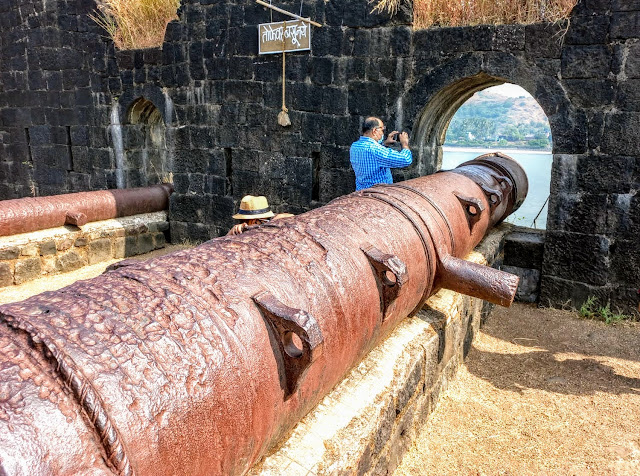
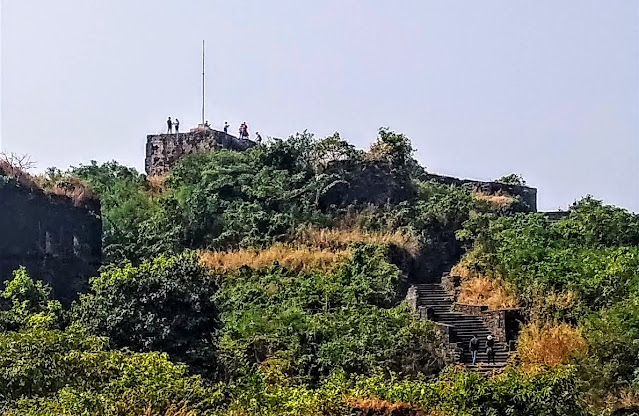
Kallal Bangdi, the 3rd largest and 4th heaviest cannon in India weighing about 22 Tons, situated on the one of the bastions above the main gate of Murud-Janjira Fort.
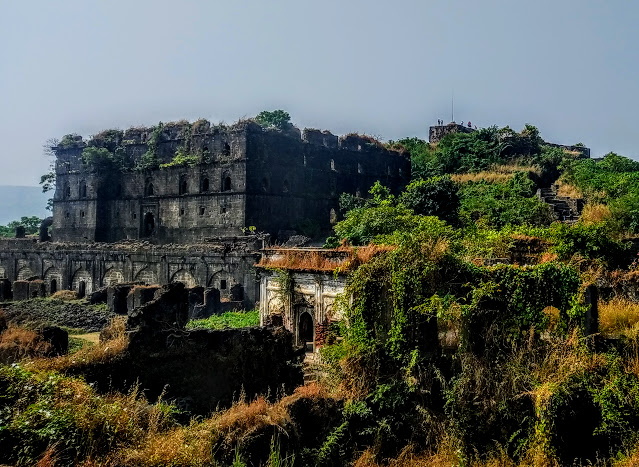
The ruined Royal Palace inside the Fort.
The flag-post - the highest point in the Fort.
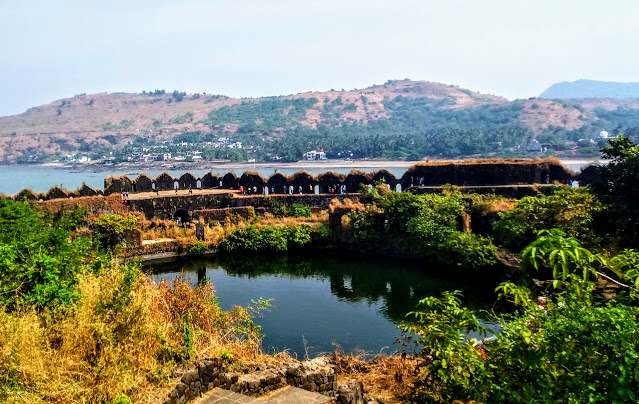
The largest of two sweet-water ponds inside the Fort.
View from flag-post of the Fort.
We were given only
one hour to explore the Fort to catch the return ferry on time. Otherwise, we
may have to wait for another hour to take the return ferry for which we have to pay for the ticket. So, we visited the
first three bastions over the right side of the main gate followed by a walk to
the largest of the two sweet-water ponds. We could also see from the distance
the ruined 5-storied Royal Palace and some dwelling places. Lastly, we climbed to the
flag-post – the highest point inside the Fort from where we had 360-degree panorama view.
We made it to return to the main gate on time to catch the return ferry. We
returned to Diveagar and had lunch at Rane Bandhu Khanaval. The food was tasty.
After
lunch, we visited Suwarn Ganesh temple which was hardly 2 kms from Rane Bandhu
Khanaval. We returned to our Resort by 2.30 PM. The children went for swimming
in the swimming pool of the resort while others relaxed in their rooms and verandahs.
I wish we had another hour or so to fully explore the Fort as there was so much to see inside the Fort. I have visited many Forts in Maharashtra. I found Murud-Janjira Fort superior in terms of its architecture and the planning.
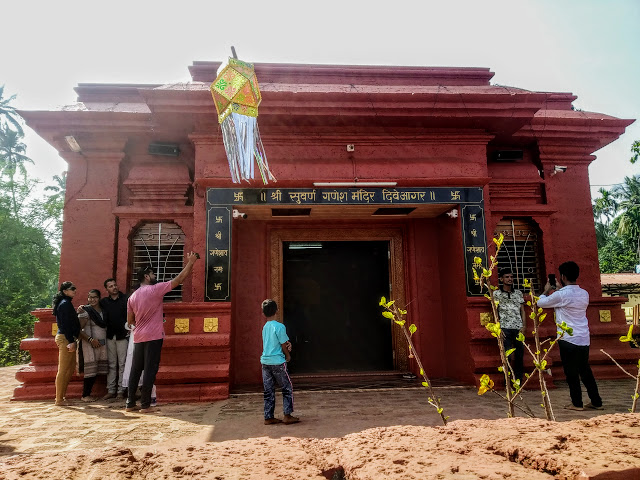
Shri Suwarn Ganesh Temple.
Day-4: Departure from Diveagar
Today, we had bigger
numbers to give us the company for the morning beach walk which we started at 06:30
AM. As we had done on the previous day morning, we walked on the northern side up
to a point where a backwater creek separated the beach from the hill on the
other side. Being Sunday, there was moderate week-end crowd on the beach. Sea-gulls
were conspicuous by their absence, probably due to crowd. After enjoying a cup
of tea on the beach, we returned to our Resort to be in time for our last
breakfast of the trip.
After check-out and some photo
shoots, we commenced our returned journey from Diveagar at 10.00 AM. With a
tea-break of about 30 minutes on the Mangaon-Kolad stretch and an hour of lunch-break at CBC, Belapur, we reached home
at 4.15 PM.
It was 3-days of pure bliss in Diveagar, getting a feel of the freedom from the shackle of the Covid-19 guidelines which confined us in the house most of the time for months.